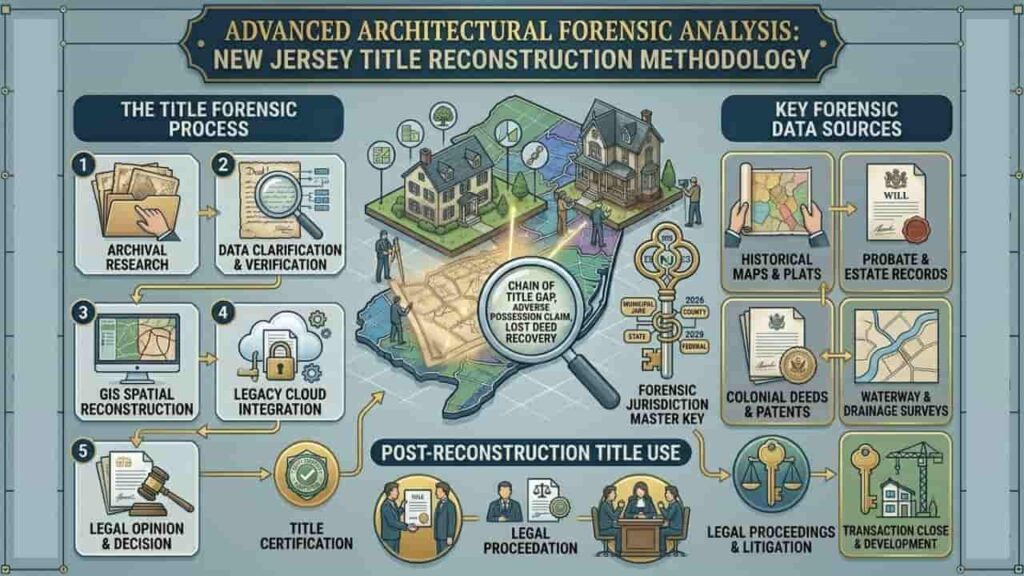
In the competitive 2026 New Jersey real estate market, a property’s history is the ultimate due diligence asset. Beyond simple storytelling, a forensic Chain of Title reconstruction is essential for identifying hidden liens, riparian rights, and structural evolution. This authoritative guide details the expert level technical workflow required to manage New Jersey’s decentralized archives transitioning seamlessly from modern digital portals to 17th century colonial land grants. Master the methodology used by elite title examiners to secure high stakes investments and ensure absolute legal clarity in the Garden State.
1. Establishing the Chain of Title
The “Chain of Title” is the chronological sequence of every ownership transfer in a property’s history. In New Jersey, this search begins at the County Clerk’s Office (sometimes referred to as the Register of Deeds), the official recorder of all local land transactions.
- Initial Identification
You must first gather the property’s “DNA” the street address, parcel number (APN), and current owner’s name. - Grantor Grantee Indexes
Most counties now provide searchable online databases, such as the Open Public Record Search (OPRS), for records dating back roughly to the 1970s. - Archival Gaps
For older transfers, you must often visit the physical “Record Room” at the county courthouse to pull deed books that have not yet been digitized. - Recital Section
Expert researchers prioritize the “Recital” section in deeds, which often cites the previous deed’s book and page number, facilitating a faster backward search.
2. Official Research Centers and Historical Repositories
New Jersey features a unique, two tier archival system. While counties handle modern records, the New Jersey State Archives in Trenton acts as the central repository for historical public records.
| Authority | Data Category | Professional Utility |
| County Clerk/Archives | Modern Deeds & Mortgages | Establishing the 20th and 21st century chain. |
| NJ State Archives | Colonial & Proprietary Records | Accessing deeds (1660s–1880s) and probate records (1670–1900). |
| Municipal Building Dept. | Construction Permits | Identifying original architects, builders, and structural changes. |
| NJ State Library | City Directories & Maps | Researching past occupants and neighborhood evolution. |
3. Advanced Forensic Tools for Property Reconstruction
To build a complete “biography” of a house, you must go beyond the deed and investigate the physical and social evolution of the property.
- Sanborn Fire Insurance Maps
These highly detailed maps (roughly 1867–1970) provide building footprints, materials used, and street number changes over time. - Tax Ratables and Assessments
Sudden spikes in a property’s assessed value often correlate with the year the home was originally constructed or significantly renovated. - Wills and Probate Records
If the chain of title breaks, the property likely passed through inheritance; the State Archives and County Surrogate offices hold critical probate records dating back to 1670. - Historic Preservation Awards
For properties with significant architectural integrity, check the Somerset County Historic Preservation or similar local award nominations for pre existing research.
4. Strategic Researcher’s Checklist
- Verify Legal Descriptions.
Compare the deed’s survey terms with local plat maps to ensure the physical property matches the historical description. - Check for Surviving Liens.
Search for active contractor liens, tax judgments, or unresolved estate claims that may still be attached to the title. - Audit Easements.
Identify any historical right of way or utility restrictions that may limit current use of the land. - Consult Professional Examiners.
For complex historical properties (e.g., rural lots or inherited estates), a professional title examiner is recommended due to the high rate of defects in handwritten filings.
5. Supplementary Technical Tool sets
To augment the paper trail, expert researchers integrate specialized datasets to visualize the property’s structural and environmental evolution.
- Sanborn Insurance Maps
Vital for tracking building materials and footprint changes from 1884 to 1923. - Historical Aerial Photography
County archives often maintain collections (e.g., 1947, 1957, 1997) to document land use shifts and structural additions. - Road Returns
Surveys dating back to the 18th century provide original mapping of road layouts relative to early property lines.
6. Professional Insights for 2026
Expert Note. In 2026, the average title search takes 3 to 10 business days, though rural properties with handwritten records may take up to 14 days. Always confirm that any discovered liens have a formal “release” filed in the county records before concluding your research.
Conclusion
Mastering the reconstruction of New Jersey property records is a vital skill for anyone operating in the high stakes real estate market of 2026. Whether you are performing a Chain of Title analysis for legal due diligence or conducting an Intensive Level Survey for historic preservation, the accuracy of your data is your greatest asset. By synthesizing modern digital tools like OPRS and NJGIN with the physical archives of the New Jersey State Archives, you move beyond a simple address and gain a forensic understanding of the land’s legal and structural DNA. In a state with a history as dense and regulated as New Jersey, this level of technical command is what separates professional investors and historians from the rest of the market.
FAQS
How can I find the complete “Chain of Title” for a New Jersey property?
To reconstruct a complete Chain of Title, you must systematically link Grantor (seller) and Grantee (buyer) records. Start with your modern deed at the County Clerk’s Office and work backward using the “Recital” section to find previous book and page numbers. For records predating the late 1700s, you must transition your search to the New Jersey State Archives in Trenton to access colonial and proprietary records.
Why are some owner names hidden or “Redacted” in NJ property records?
In accordance with Daniel’s Law, New Jersey redacts the home addresses and names of “covered persons” including active and retired judges, prosecutors, and law enforcement officers from all public facing government databases. If a parcel shows as “Redacted,” you may need to utilize alternative verification methods through non public legal channels or title companies to confirm ownership
Are NJ GIS parcel boundaries legally accurate for boundary disputes?
No. New Jersey GIS parcel data is intended for graphical and planning purposes only and is not a legally binding survey. While GIS tools like NJ GeoWeb are excellent for identifying environmental constraints (such as wetlands), a physical survey performed by a licensed New Jersey Land Surveyor is the only way to legally determine property lines.
How do I determine if a New Jersey home is officially designated as “Historic”?
You should consult the New Jersey Historic Preservation Office (HPO) or the National Register of Historic Places digital archives. Professionals often check the HPO Known Historic Properties List to see if a site has undergone an “Intensive Level Survey,” which documents its architectural and historical significance.
Where can I access historical maps to see how a property has changed over time?
The most authoritative resources for structural evolution are Sanborn Fire Insurance Maps (1867–1970) and Historical Aerial Photography available through county archives. These tools allow you to track changes in building footprints, materials, and land use shifts, such as the transition from farmland to residential subdivisions.