In the high-tax landscape of 2026, navigating New Jersey’s property tax system requires professional-grade transparency. While standard listings offer estimates, strategic investors and homeowners rely on authoritative state databases to verify precise assessments, historical trends, and certified tax liabilities. This expert guide breaks down the top five official, free-to-use digital portals from the Rutgers MOD IV archive to the NJ Transparency Center empowering you to perform forensic due diligence, identify assessment anomalies, and secure absolute financial clarity before committing to a Garden State acquisition.
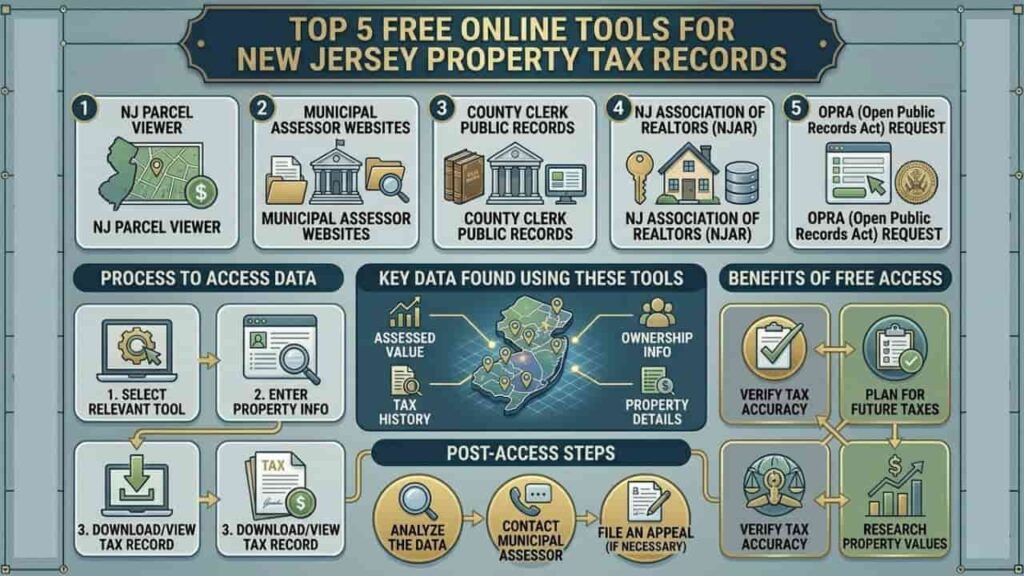
1. NJ MOD IV Historical Database (Rutgers)
The MOD IV Historical Database, managed by Rutgers University and supported by the NJ Department of Community Affairs, is the industry standard for long-term data. It contains over 30 years of New Jersey real estate parcel records, making it the most comprehensive tool for analyzing property trends.
- Primary Data:
30+ years of parcel information, including property class and exemptions. - Best Feature:
All data is downloadable in CSV format, allowing users to conduct advanced analysis in Excel. - Pro Tip:
Use the “Tour” buttons on the portal to walk through complex query features.
2. YourMoney.NJ.Gov (NJ Transparency Center)
The New Jersey Transparency Center offers a highly accessible, map-based interface designed for the general public. It provides a quick visual snapshot of a property’s financial standing.
- Primary Data:
Annual assessed values (land and building), prior year’s taxes, and property classification. - Best Feature:
The “Property Explorer” map format allows you to search by address or block/lot and see surrounding parcel data visually. - Best For:
Homeowners looking for a simplified overview of their recent tax history.
3. NJ Property Tax List Search (Treasury Department)
Maintained by the NJ Division of Taxation, this tool is the official source for the annual tax lists submitted by municipal assessors.
- Primary Data:
Official assessment records as of January 10 each year. - Limitation:
Ownership transfers or changes occurring after the tax list is certified will not be reflected until the following year. - Strategic Use:
Use this for verifying the “Certified” assessment used for legal tax appeals.
4. NJ-TaxRecords.com (Municipal Standard)
Many major municipalities, such as Jersey City, officially direct residents to this portal for current assessment data. It is often the most frequently updated site for municipal-level changes.
- Primary Data:
Current assessments, property location details, and owner names. - Expert Application:
This is the fastest way to pull a “Property Record Card” which details the interior features of a home that contribute to its tax value.
5. County Board of Taxation Portals
Individual counties such as Morris, Sussex, and Ocean maintain their own specialized search engines. These often contain localized sales data that state-level sites may miss in the short term.
- Key Advantage: County sites like the Morris County Tax Board allow searches by “Prior Block and Lot,” which is vital for researching recently subdivided land.
- Sussex County: Their system specifically links tax board records to the County Clerk’s property records for seamless title tracing.
Comparing the 2026 NJ Property Tax Portals
| Portal Name | Data Depth | Best Use Case |
| NJ MOD IV (Rutgers) | 30+ Years | Bulk data downloads and historical trends. |
| YourMoney.NJ.Gov | Current & Prior Year | Quick address-based map searches. |
| NJ Treasury Search | Annual Certified List | Official data for tax appeal filing. |
| NJ-TaxRecords.com | Live Municipal Data | Accessing current property record cards. |
| County Portals | Localized Updates | County-specific accuracy and subdivision history. |
Step-by-Step Guide: Performing Your First Search
To get the most accurate results, follow this professional methodology used by New Jersey title examiners:
Step 1: Gather Your Identifiers
In New Jersey, street addresses can sometimes be inconsistent in government databases. Always have the County, Municipality, Block, and Lot numbers ready. You can find these on your latest utility bill or original deed.
Step 2: Cross-Reference Multiple Sites
Start at YourMoney.NJ.Gov for a visual check. Then, verify the current year’s exact assessment on NJ-TaxRecords.com to ensure you have the most recent municipal updates.
Step 3: Account for Daniel’s Law
Be aware that as of 2026, many public portals including the Rutgers MOD IV Database have redacted “Owner Name” fields to comply with Daniel’s Law. This law protects the privacy of certain public officials, so you may only see “Redacted” in the owner’s field.
Conclusion
Using these five tools allows you to bypass expensive private search services and go directly to the source. By leveraging the MOD IV Database for history and YourMoney.NJ.Gov for modern visibility, you gain a professional-grade understanding of any New Jersey property’s tax obligations in 2026.
How often are tax records updated?
Most official state tax lists are updated annually in January. However, municipal-specific portals may update assessment changes more frequently throughout the year.
Can I see if someone has paid their property taxes?
Assessment portals generally show the amount owed, not the payment status. To check if taxes are actually paid, you must visit the specific Municipal Revenue Collection or Tax Collector’s website for that town.
Why is my assessment different from my market value?
Assessment is a value determined by a municipal assessor for tax purposes, often based on a “Base Year”. It rarely matches 100% of the current market selling price.
Is this data free to the public?
Yes. All tools listed in this guide are provided by the State of New Jersey, Rutgers University, or County Tax Boards as free public services.