While New Jersey is famous for having the highest property tax rates in the nation, the state constitution provides powerful, little known relief programs that allow certain residents to completely wipe out their tax obligations. We are not talking about standard rebate checks like ANCHOR or Senior Freeze. We are talking about legal, 100% permanent property tax exemptions. Meeting the statutory requirements for total tax free status requires a clear understanding of state tax codes. If you are a disabled veteran, a surviving spouse, or represent a qualifying non profit organization, New Jersey law offers clear administrative paths to eliminate your real estate tax burden entirely.
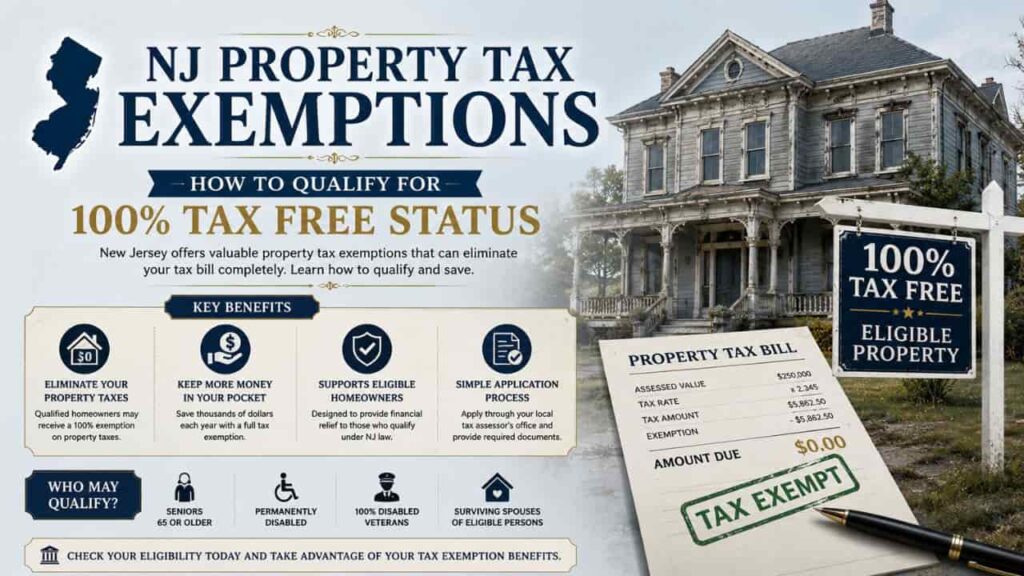
The 100% Disabled Veteran Property Tax Exemption
The most comprehensive property tax benefit in the Garden State is reserved for the honorable individuals who sacrificed their health in military service. Under New Jersey Statute N.J.S.A. 54:4-3.30, qualified honorably discharged veterans can claim a complete, 100% exemption from property taxes on their primary residence.
To secure this tax free status, the state enforces a strict set of statutory qualifications.
- Honorable Discharge.
You must have a valid DD-214 form confirming an honorable separation from active duty service in the United States Armed Forces. - Total and Permanent Disability.
The U.S. Department of Veterans Affairs (VA) must officially certify your service connected disability rating at 100% permanent and total. - Primary Residency Ownership.
You must legally own the real estate and occupy the dwelling as your legal, full time primary residence in New Jersey.
If you meet these markers, the municipal tax assessment on your dwelling and land drops to zero. Furthermore, if you pass away, this tax free status passes directly to your unmarried surviving spouse, ensuring they remain protected from high local tax levies.
Annual Property Tax Deductions for Seniors and Veterans
If you do not qualify for a total 100% exemption, New Jersey offers permanent, fixed annual tax deductions that lower your liability directly at the municipal level. These deductions are built into the state constitution and are completely independent of seasonal state budget funding or annual rebate rollouts.
(Your Local Tax Levy) ➔ Minus Statutory Deductions ($250 Senior / $250 Veteran) ➔ Your Final Net Tax Bill
The state provides two primary annual deduction tracks that can be applied directly to your local property tax ledger.
1. The Senior Citizens, Disabled, or Surviving Spouse Deduction
This program provides a reliable, flat $250 annual deduction from your real estate tax bill. To qualify, you must be 65 years or older, or permanently and totally disabled, with a total annual income of $10,000 or less (excluding your Social Security benefits or specific government pensions).
2. The Standard Veterans Deduction
Honorably discharged veterans who served on active duty during statutory periods of war or conflict can claim an annual $250 property tax deduction. Unlike the senior deduction, there are absolutely zero income limits or asset caps required to secure this benefit.
Step by Step Exemption Application Framework
Securing your tax free status or active duty deduction requires submitting precise documentation through your local municipal tax assessor. The state utilizes standardized forms to process these requests, and errors on these applications can delay your approval for months.
1. Download the Official State Application (Identify Your Specific Form)
Access the NJ Division of Taxation portal to secure your form. If applying for the total disabled veteran exemption, download Form D.V.E.S.S. If applying for the baseline senior or veteran deduction, secure Form V.S.S.
2. Gather Required Statutory Evidence (Assemble Your Verification Papers)
Collect your supporting documents. You will need your military DD-214, your official 100% Permanent and Total VA disability award letter, and proof of New Jersey residency, such as a valid driver’s license and utility bills.
3. File the Application Packages (Submit to Your Township Assessor)
Deliver the completed application package directly to your local municipal tax assessor’s office. The assessor processes the files, verifies the active duty data, and applies the structural exemption status to the upcoming tax list duplicate.
Non Residential and Religious Property Tax Exemptions
New Jersey also grants complete, 100% property tax exemptions to specific organizations that use real estate for the public good. Under N.J.S.A. 54:4-3.6, buildings used exclusively for religious, charitable, scientific, or educational purposes are completely exempt from local real estate extractions.
| Organization Asset Type | Core Statutory Requirement | Essential Application Form |
| Religious Institutions | Houses of worship, parsonages, and immediate grounds used exclusively for religious ceremonies and operations. | Form I.S. (Initial Statement) |
| Charitable Organizations | Non profit groups organized exclusively for public benefit, housing, or humanitarian aid networks. | Form I.S. (Initial Statement) |
| Fraternal & Vet Organizations | Non profit structures used specifically for veteran support groups, fraternal lodges, or historical associations. | Form I.S. (Initial Statement) |
To maintain this tax free status, these organizations must file a Further Statement (Form F.S.) every three years with the municipal tax assessor. This mandatory update proves the property’s usage has not shifted into commercial, profit generating operations.
The Structural Timing Advantage. If your application for a 100% Disabled Veteran Property Tax Exemption is approved mid year, New Jersey law allows your local municipal government to refund any property taxes you paid after your official disability date. Contact your local municipal council, as they have the explicit statutory authority to pass an official resolution retroactively canceling your historical tax debts back to your initial VA rating effective date.
Conclusion
Securing a 100% property tax exemption or an asset saving annual deduction is the ultimate way to eliminate the crushing weight of New Jersey’s local tax levies. By carefully reviewing the statutory criteria for Form D.V.E.S.S. and Form V.S.S., gather your official military or income documentation and file directly with your township assessor. Taking control of these legal frameworks ensures you protect your home, preserve your hard-earned equity, and secure the full tax-free benefits you are legally entitled to under New Jersey law.
FAQs
Who qualifies for a 100% property tax exemption in New Jersey?
Honorably discharged veterans with a 100% permanent and total service connected disability rating from the VA qualify for complete exemption on their primary residential properties.
What is Form D.V.E.S.S. used for?
Form D.V.E.S.S. is the official state application that disabled veterans must file with their municipal tax assessor to claim a 100% property tax exemption.
Does the NJ disabled veteran tax exemption cover rental properties?
No. The 100% property tax exemption applies strictly to the dwelling house and land that serves as the veteran’s actual, legal primary residence.
Can an unmarried surviving spouse keep the 100% tax exemption?
Yes. The complete property tax exemption transfers directly to the unmarried surviving spouse after the qualifying veteran passes away, provided they remain in the home.
What is the New Jersey $250 Senior Property Tax Deduction?
It is a constitutional benefit that cuts $250 annually from the tax bills of low income seniors aged 65 or older who meet specific asset requirements.
What are the income limits for the $250 senior tax deduction?
Your total annual income must be $10,000 or less, completely excluding your Social Security benefits or specific federal and railroad retirement pensions.
What is Form V.S.S. used for in NJ?
Form V.S.S. is the standard application used by residents to formally claim the $250 annual deduction for senior citizens, disabled individuals, or surviving spouses.
How do religious organizations get a 100% tax exemption in NJ?
Churches and religious groups must file Form I.S. with the municipal assessor, proving the real estate is used exclusively for non profit religious or parsonage operations.
What is the Further Statement (Form F.S.) requirement?
Tax exempt non profits and religious organizations must file Form F.S. every three years to verify their properties continue to meet the state’s strict non profit guidelines.
Can you combine the senior and veteran property tax deductions?
Yes. If you are a senior citizen who is also an honorably discharged veteran, you can legally combine both deductions to save $500 annually on your taxes.