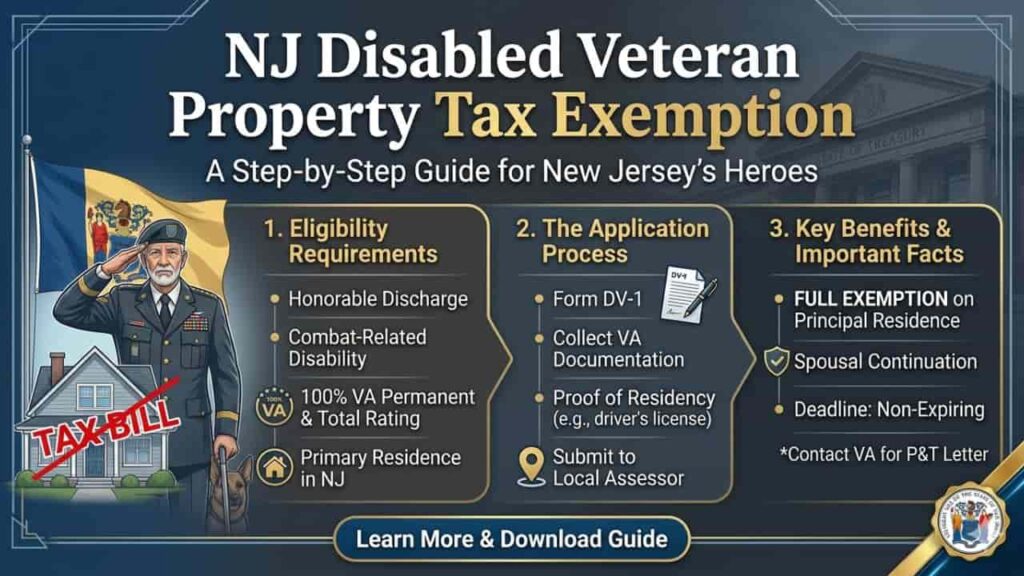
New Jersey provides a full property tax exemption on the principal residence for honorably discharged veterans who have a 100% permanent and total service connected disability. This significant benefit is designed to support those who have sacrificed their health in service to the United States. For New Jersey veterans who have given so much in service to their country, the state offers a significant financial benefit. A total exemption from municipal property taxes. If you are an honorably discharged veteran with a 100% permanent and total service connected disability, your primary residence may be completely tax free. This guide explains the eligibility requirements, the application process via Form DVSSE, and additional tax perks available in 2026. This comprehensive details the eligibility requirements, application steps, and additional tax benefits available to New Jersey’s disabled veterans in 2026.
Core Eligibility Requirements for Full Exemption
To qualify for a total exemption from municipal property taxes, a veteran must meet several strict criteria established by the state and the U.S. Department of Veterans Affairs (VA).
Service and Disability Status
- Military Discharge. The applicant must be an honorably discharged veteran of the United States Armed Forces.
- Disability Rating. The veteran must be determined by the VA to have a 100% permanent and total service connected disability.
- Specific Impairments. Eligibility also extends to veterans with specific permanent impairments resulting from active duty, such as blindness or the loss of limbs.
Residency and Property Ownership
- Primary Residence. The exemption applies only to the veteran’s principal residence.
- Ownership. The veteran must legally own the home for which the exemption is being claimed.
- State Residency. The applicant must be a legal resident of New Jersey.
Exemption for Surviving Spouses
New Jersey law ensures that the property tax relief provided to a disabled veteran continues for their family in the event of their passing.
Maintaining Eligibility for Spouses
- Marital Status. The exemption extends to a surviving spouse (or civil union partner) provided they do not remarry or enter a new civil union.
- Residency and Ownership. The surviving spouse must continue to own and occupy the home as their primary residence to keep the benefit active.
Step by Step Application Process, Form DVSSE
The application for this property tax exemption is handled at the local municipal level rather than through a state wide portal.
Step 1. Obtain the Correct Form
Veterans must file the Claimant’s Certification of Service Connected Disability, officially known as Form DVSSE.
Step 2. Collect Required Documentation
A complete application packet must include.
- VA Certification Letter. An official letter from the VA certifying the 100% permanent and total service connected disability.
- Discharge Papers. Documentation verifying an honorable discharge from the Armed Forces.
- Proof of Ownership. Evidence that the veteran owns the property in question.
Step 3. Submit to Local Officials
The completed Form DVSSE and all supporting documents must be filed with the local municipal Tax Assessor or Collector.
Additional Tax Benefits for NJ Disabled Veterans.
Beyond property tax exemptions, New Jersey offers further financial relief to its disabled veteran population.
Vehicle Sales and Use Tax Exemption
VA Authorization. This specific benefit is only available if the purchase or lease is authorized by the VA.
Exemption Scope. Disabled veterans may be exempt from paying sales and use tax on the purchase or lease of a motor vehicle.
State Income Tax Protections
- VA Benefits. New Jersey does not tax VA disability benefits. This ensures that disability compensation remains fully available to the veteran for their living expenses.
NJ Veteran Benefit Summary Table (2026)
| Benefit Type | Level of Relief | Primary Requirement |
| Property Tax | 100% Full Exemption | 100% P&T Disability Rating |
| Surviving Spouse | Full Continuation | Must remain unmarried |
| Vehicle Tax | Sales Tax Exemption | VA authorization required |
| NJ Income Tax | 0% Taxed | VA disability benefits are non taxable |
Strategic Summary for Disabled Veterans
- Honorable Discharge. Essential for all New Jersey veteran benefits.
- Principal Residence. You must own and live in the home to qualify.
- Direct Application. Use Form DVSSE and submit it directly to your town’s tax office.
- Surviving Families. Protection extends to spouses who do not remarry.
- Total Savings. This exemption covers the entire municipal property tax bill, providing significant long term financial security.
Notice of Denial
If your NJ Disabled Veteran Property Tax Exemption application (Form DVSSE) is denied by your local tax assessor, you have the legal right to challenge the decision through a structured appeal process. Follow these steps to resolve the issue and secure your benefits.
Step by Step Appeal Process for Denied Applications
Step 1. Obtain the Written Notice of Denial
Request a formal written statement from your Municipal Tax Assessor. This document is critical because it identifies the specific reason for rejection whether it was due to an incomplete VA Certification Letter, an error on Form DVSSE, or a dispute regarding your primary residency status.
Step 2. Correct Administrative or Clerical Errors
If the rejection was based on missing or outdated information, you may be able to resolve the issue without a formal appeal. Ensure your DD-214 shows an honorable discharge and that your VA letter explicitly states a 100% Permanent and Total (P&T) disability rating. Resubmit the corrected packet to the assessor for reconsideration.
Step 3. File a Petition with the County Board of Taxation
If you disagree with the assessor’s legal interpretation of your eligibility, you must file a formal appeal with your County Board of Taxation.
- Deadline. Generally, appeals must be filed by April 1st (or 45 days from the date the assessment notification was mailed).
- The Hearing. You will attend a hearing where the board reviews your VA documentation and property records to determine if the local assessor correctly applied New Jersey state law.
Step 4. Escalate to the New Jersey State Tax Court
If the County Board denies your petition, your final administrative remedy is to file an appeal with the Tax Court of New Jersey.
- Timeframe. This must typically be done within 45 days of the County Board’s judgment.
- Professional Review. The State Tax Court handles complex legal disputes and provides a highly authoritative review of your case to ensure all veteran tax exemptions are granted according to state statutes.
Summary of Appeal Levels
| Appeal Stage | Authority | Key Focus |
| Initial Denial | Municipal Tax Assessor | Missing documents or clerical errors |
| First Appeal | County Board of Taxation | Review of VA status and residency |
| Final Appeal | NJ State Tax Court | Legal interpretation of state veteran laws |
For immediate assistance during a rejection, contact the NJ Division of Taxation or your local veterans’ service officer to ensure your documentation aligns with the latest 2026 compliance standards.
Conclusion
The NJ Disabled Veteran Property Tax Exemption is a vital financial benefit that provides a 100% tax free primary residence for those with a total service connected disability. By filing Form DVSSE with your local tax assessor and providing your VA certification letter, you can eliminate the burden of municipal property taxes entirely. This protection, which also secures the future of surviving spouses, ensures that New Jersey’s heroes can maintain their homes with the dignity and financial security they deserve.
FAQs
Who is eligible for the full NJ disabled veteran property tax exemption?
Honorably discharged veterans with a 100% permanent and total service connected disability, as certified by the VA, are eligible. You must also be a New Jersey resident and own the home as your principal residence.
What form do I need to file for the veteran tax exemption in NJ?
You must complete and file Form DVSSE (Claimant’s Certification of Service Connected Disability) with your local municipal tax assessor or collector.
Does the property tax exemption apply to surviving spouses?
Yes. The exemption continues for a surviving spouse or civil union partner, provided they remain unmarried and continue to own and live in the home as their primary residence.
What documents are required for the NJ veteran tax exemption application?
You generally need your DD-214 (discharge papers), a VA certification letter confirming your 100% P&T status, and proof of property ownership.
Are there other tax benefits for disabled veterans in New Jersey?
Yes. Disabled veterans may be exempt from sales and use tax on vehicle purchases or leases if authorized by the VA. Additionally, NJ does not tax VA disability benefits.
Can I get a tax exemption for a property other than my main home?
No. The law specifically states that the exemption only applies to the veteran’s principal residence which they own and occupy.
Is there a deadline to file Form DVSSE?
While you should file as soon as you receive your 100% rating, you must contact your local municipal Tax Assessor for specific local filing windows or effective dates for the exemption.
Do I qualify if my disability is less than 100%?
The full property tax exemption is strictly for those with a 100% permanent and total rating or specific severe permanent impairments like total blindness or loss of limbs resulting from active duty.