New Jersey property taxes are notoriously high, but the heavy financial extraction is not felt equally across every town. While the statewide effective property tax rate averages an intense 2.23%, a structural anomaly exists where certain municipalities manage to offer excellent public services alongside surprisingly low tax rates. The secret weapon behind these lower tax bills is not a sudden wave of municipal spending cuts. Instead, it is the size, health, and composition of the local commercial ratable base. Understanding how corporate, industrial, and commercial properties alleviate the financial extraction on everyday homeowners requires a deep dive into the localized mechanics of New Jersey tax mathematics.
The Concept of Tax Ratables, Commercial vs Residential
In Garden State municipal finance, any parcel of real estate that can be officially taxed is classified as a ratable. The total combination of these parcels within a town’s borders forms its ratable base. Every year, the municipal government, the county, and the local school district calculate their total operating expenses, subtract non tax revenue (like state aid, licensing fees, and permits), and arrive at a final dollar figure known as the total tax levy. This is the exact amount of cash that must be raised via property taxes to balance the municipal checkbook.
To determine the actual tax rate, the township uses a straightforward structural formula.

Total Tax Levy Needed ÷ Total Value of All Properties = Local Property Tax Rate
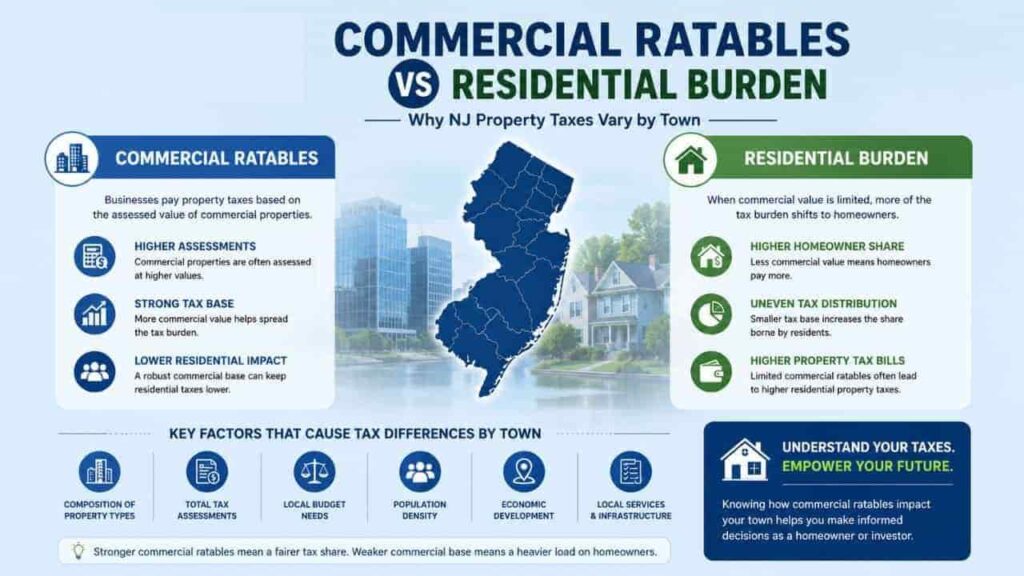
When a municipality features major corporate corridors, mega warehouses, retail shopping malls, or logistics parks, these massive entities pull immense weight. They are highly valued properties that contribute millions of dollars directly into the taxable pool. Because commercial ratables expand the denominator of the equation, the overall tax rate automatically drops for everyone in the town provided spending stays flat. This dynamic creates a steady municipal subsidy that directly lowers the financial extraction on residential homeowners.
The Service Efficiency of Corporate Entities
Commercial properties provide a unique financial advantage because they create a massively disproportionate tax to service ratio. In short, businesses pay premium tax dollars but demand very little from local infrastructure.
- No Public School Burden.
The single largest component of any New Jersey property tax bill is the local school district budget, which typically gobbles up 50% to 65% of every tax dollar collected. Commercial properties generate zero school aged children. A 500,000 square foot Amazon fulfillment center or a premium corporate park pays millions in property taxes without adding a single student to the local classroom. - Minimized Municipal Infrastructure Strain.
While massive industrial facilities require solid road access, they typically handle their own internal security, specialized waste management, and site maintenance. They do not utilize municipal trash collection, community senior centers, or local parks, making them highly efficient tax engines.
Conversely, high density residential developments often draw in more in municipal service and public education costs than they contribute in baseline real estate taxes. This reality fuels the aggressive “ratables chase,” where local planning boards intentionally zone highway corridors specifically for retail and commercial use to actively protect their residents from escalating tax burdens.
Local Tax Anomalies, Towns Subsidized by Commerce
The clearest way to see the impact of corporate ratables is to look at New Jersey’s stark regional tax anomalies. Towns with small borders but massive commercial centers boast incredibly low effective tax rates compared to landlocked, purely residential suburbs.
| Municipality | County | Primary Commercial Driver | Local Tax Base Dynamic |
| Teterboro | Bergen | Teterboro Airport & Industrial Hub | Minimal residents split an immense commercial funding pool, resulting in ultra low tax bills. |
| Paramus | Bergen | Retail Malls & Massive Route 4/17 Commercial Corridors | Heavy retail sales and property taxes drastically lower the residential real estate tax rate. |
| Lower Alloways Creek | Salem | Nuclear Power Generation Stations | The massive utility infrastructure base carries nearly the entire local municipal operating budget. |
In stark contrast, look at a community like the Borough of Metuchen in Middlesex County. Metuchen is a gorgeous, highly desirable “donut hole” town with fantastic historic charm, but its land use is roughly 80% residential. Because it lacks sprawling highway retail zones, massive distribution warehouses, or corporate office plazas, its homeowners are forced to carry almost the entire local tax levy.
A home valued at $700,000 in a purely residential town can easily carry an annual tax bill exceeding $16,000, while that exact same asset in a heavily commercialized, asset rich town might pay thousands less simply because corporate neighbors absorb the shock.
Split Allocation, School Districts and Municipal Budgets
To understand how your annual real estate tax bill is broken down and distributed, it helps to look at the three distinct governmental layers that claim a piece of the pie. Every single check you write to your local tax collector is carved up and sent out to fulfill separate, legally independent budgets.
[Your Total Tax Bill] ➔ 55% School District | 30% Municipal Government | 15% County Level
1. The School District Allocation (Typically 50% to 65%)
This is the uncontested giant of New Jersey property taxation. If a town does not have a robust commercial presence to help fund its public schools, residential property owners must shoulder the cost of teacher salaries, facility upkeep, and special education programs. Towns with high concentrations of commercial property enjoy a major buffer here, as corporate tax dollars flow directly into school funds without increasing enrollment.
2. The Municipal Government Allocation (Typically 25% to 35%)
This portion funds your immediate local services, including the police department, public works, road resurfacing, and local administrative staff. Commercial zones require specialized police and fire protection, but the tax revenue generated by these business parks heavily outweighs their emergency service consumption.
3. The County Allocation (Typically 10% to 15%)
Your county government collects a small percentage from every municipality to fund regional infrastructure, county court systems, county parks, and regional correctional facilities.
The Investor and Homeowner Takeaway. When you are performing a New Jersey property search to purchase a primary residence or a real estate investment asset, do not look solely at the house itself. Open the municipal tax map and analyze the local commercial zoning. Buying in a town with a healthy, diverse mix of corporate ratables, logistical hubs, or robust highway retail space provides a long term structural shield against the aggressive tax increases common to purely residential suburbs.
Conclusion
The health of a New Jersey municipality’s commercial ratable base is the ultimate structural differentiator in determining local property tax rates. Purely residential towns force homeowners to shoulder the immense fiscal burden of local school districts and municipal infrastructure alone. Conversely, investing in strategic NJ communities supported by corporate corridors, logistics warehouses, and retail hubs provides a long term shield against escalating real estate tax extractions. To maximize your real estate portfolio’s profitability, always analyze local zoning balances before acquiring any property.
FAQs
Why are property taxes so high in New Jersey?
NJ taxes lead the nation because local public schools, municipal services, and county infrastructure are funded almost entirely through property levies rather than regional or state commercial subsidies.
What is a “tax ratable” in New Jersey municipal finance?
A tax ratable is any commercial, industrial, or residential real estate parcel that can be officially assessed and taxed by the municipality to generate local revenue.
How do commercial properties reduce residential property tax bills?
Commercial entities pay premium property taxes but add zero students to local public school systems, significantly expanding the tax base denominator without increasing local educational spending.
What percentage of NJ property taxes goes to local schools?
On average, the local school district budget consumes between 50% to 65% of every single dollar collected by the municipal tax office.
Why do purely residential towns have higher effective tax rates?
Without retail centers or corporate office parks to absorb the financial levy, everyday homeowners must carry 100% of the local municipal and school operational budgets.
What is a corporate tax ratable corridor?
It is a zone dedicated to office complexes, retail centers, or manufacturing facilities along major highways (like Route 4, 17, or 1) that generates immense municipal revenue.
Do warehouses increase or decrease local residential property taxes?
Industrial warehouses generally lower residential taxes because they contribute substantial property tax dollars while demanding minimal municipal services or public infrastructure upkeep.
How does municipal zoning impact my property tax bill?
Towns that prioritize commercial zoning can easily balance their municipal budgets using corporate money, shielding residential homeowners from aggressive annual real estate tax increases.
What is the total tax levy formula in NJ?
The tax levy equals the town’s total operating expenses minus non tax revenues. This final net dollar amount must be raised entirely through local property taxes.
Where can I find a town’s commercial tax base data?
You can review a municipality’s official Abstract of Ratables, published annually by the County Board of Taxation, to see the exact ratio of commercial vs. residential property.