Before you ever file an official property tax appeal in New Jersey, your absolute first step must be a forensic review of your home’s public records. Many Garden State homeowners assume their tax bill is automatically calculated by an error free computer system. In reality, your bill is driven by human inputs inside the municipal tax assessor’s database. These local inputs are stored on a document known as the Property Record Card (PRC) or the Tax Assessor’s Field Book Record. Under New Jersey’s state standardized MOD-IV tax data system, even a tiny clerical typo regarding your home’s structural dimensions or utility line items can cause your annual assessment to increase significantly. Learning how to pull and decode this card allows you to catch hidden structural errors before they drain your bank account.
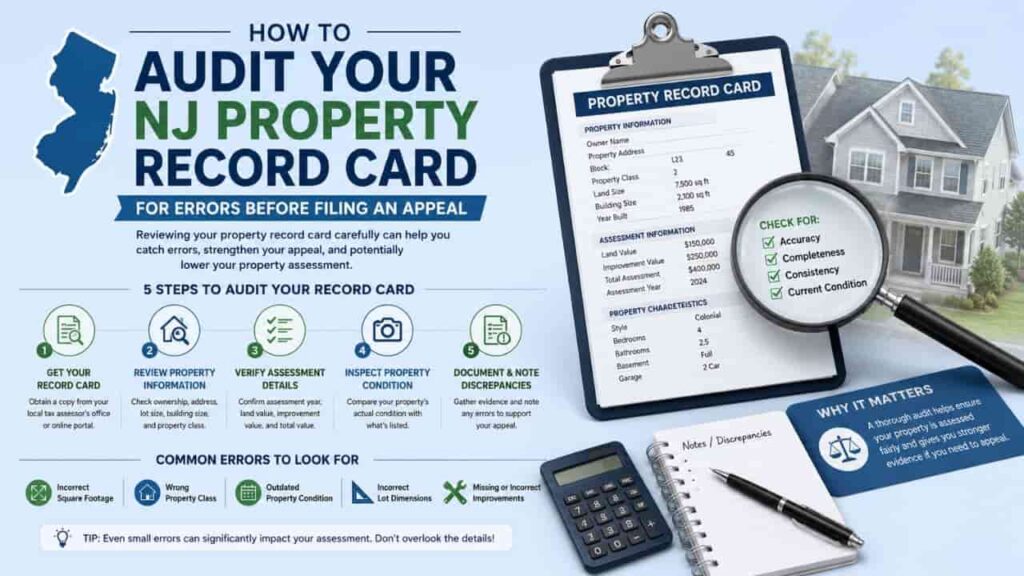
How to Pull Your Property Record Card
You cannot find structural errors by looking at your quarterly tax bill or your annual Chapter 75 assessment postcard. You must obtain the full, raw field data sheet used by your township assessor.
1. View Your Public Summary Online (Search the State MOD-IV System)
Visit the official NJACTB open portal to quickly check your property’s baseline data. Simply select your county and town, input your block and lot numbers, and review your public assessment profile to instantly see the foundational details the state has on file.
2. Request Your Complete Layout Sketch (Connect with Your Municipal Portal)
To see the exact structural footprint and measurements of your home, visit your local township hall or check your municipal tax assessor’s official web page. Simply ask for a copy of your full “Property Record Card with layout sketch” to verify the exact structural inputs.
3. Use standard public access paths (Submit an OPRA Form for Full Details)
Utilize New Jersey’s standard Open Public Records Act (OPRA) framework through your municipal clerk’s office to smoothly request your comprehensive property file. This routine request ensures you receive every single official appraisal code and background line item mapped to your home.
Decoding New Jersey Property Classification Codes
When you open your record card, you will notice a section labeled “Class.” The state of New Jersey utilizes strict administrative definitions under N.J.A.C. 18:12-2.2 to categorize real estate. If your residential property is misclassified under a commercial or mixed use bracket, your base valuation calculations will be flawed from the start.
[Your Property Profile] ➔ Check Class Box ➔ Ensure it matches true use (e.g., Class 2 for Residential)
The property classification system dictates the valuation rules your local assessor must apply during a township wide revaluation or a yearly structural assessment update.
| State Code | Official Property Classification | Structural Definition & Rules |
| Class 1 | Vacant Land | Idle land with zero structural improvements or active agricultural operations. |
| Class 2 | Residential Property | Dwellings functionally designed for use by 1 to 4 families, including residential condos. |
| Class 3A / 3B | Farmland / Farmland Qualified | Land actively devoted to agricultural production requiring annual qualification forms. |
| Class 4A / 4C | Commercial / Apartments | Business properties or residential complexes housing 5 or more distinct living units. |
Auditing the Structural Dimensions and Layout Sketch
Once you verify your classification code, move immediately to the bottom left section of the document to inspect the structural layout sketch. Field appraisers measure the exterior boundaries of your home and input codes to build a cost approach valuation model.
Clerical layout mistakes are the single biggest driver of inflated New Jersey property tax assessments. Check these three high risk line items immediately.
1. Livable Square Footage vs. Non Livable Storage
Assessors use precise, multi letter layout strings to calculate square footage. For example, a code like “TWO” represents two full stories of heated, livable space. Watch out for characters like “FAT” (Finished Attic) or “FHS” (Finished Half Story) if your attic is actually raw, unheated rafters. If your unfinished attic is coded as functional living space, you are paying a heavy premium for square footage you do not have.
2. The Basement Trap, Unfinished vs Finished Controls
Look closely at the basement designation codes.
- “UBM” means an Unfinished Basement (lower valuation weight).
- “FBM” means a Finished Basement (higher valuation weight).
If a previous owner pulled a permit for a basic renovation, or if an appraiser mistakenly assumed your basement was fully finished with drywall and flooring, your building value will reflect a massive asset premium. If your basement is actually just bare concrete walls and exposed pipes, this line item must be corrected.
3. Fixture Counts and Bathroom Inflation
Your card will break down your home’s absolute interior room assets. Count the bathrooms carefully. Assessors track full bathrooms and half baths separately. If a typo lists your home as having 3.5 baths when you only have 2.5, that extra non existent bathroom artificially inflates your building’s condition score.
Structural Code Matrix, Translating Your Record Card
To audit your home’s data line by line, you must understand the shorthand codes used by municipal appraisers across New Jersey. The building description block often uses a standardized formula string, Stories, Structure, Style, Garage.
[Example Code. 2S-F-L-1AG] ➔ 2 Stories | Frame Construction | Colonial Style | 1 Car Attached Garage
Use this reference table to cross reference the structural codes on your card against the actual physical state of your property.
| Code Field Category | Standard NJ Code | Real World Translation |
| Building Structure | F / B / ST / AL | Frame Construction / Brick / Stone / Aluminum Siding |
| Property Style | L / R / F / S | Colonial / Rancher / Cape Cod / Split Level |
| Garage Class | AG / UG / FGR | Attached Garage / Unattached Garage / Finished Garage |
| Porch & Deck Assets | OP / FEP / DCK | Open Porch / Finished Enclosed Porch / Open Wood Deck |
The Expert Strategy Shift. If you find a structural discrepancy on your Property Record Card such as an incorrect bathroom count, a deck that was removed years ago, or a finished basement that is actually raw storage, do not wait to file a formal appeal with the County Board of Taxation. Instead, contact your municipal tax assessor directly. Bring your card, point out the factual clerical error, and request an informal site inspection. If the assessor recognizes a clear administrative error, they can adjust your property’s card data and lower your assessment directly, saving you the time, expense, and stress of a formal legal appeal.
Conclusion
Understanding the intricacies of the NJ Tax Assessor’s Field Book shifts the balance of power back to the homeowner. By decoding your public Property Record Card, auditing structural layout codes, and identifying hidden administrative errors, you stop overpaying on your real estate assets. Never assume your town’s data is flawless. Taking the time to audit your home’s structural line items ensures your property tax assessment accurately reflects the true physical boundaries of your home, keeping your hard earned money in your pocket.
FAQs
What is a New Jersey Property Record Card?
It is the official public ledger used by your municipal tax assessor that details your home’s dimensions, construction materials, room counts, and layout assets to compute your property tax assessment.
Where can I get a copy of my home’s Property Record Card?
You can search online summaries via the New Jersey Association of County Tax Boards (NJACTB) portal or request the full layout sketch card directly from your municipal tax office.
What does “Class 2” mean on an NJ property record?
Class 2 is the official New Jersey property classification code for standard residential real estate designed to house between one and four individual families, including residential condominiums.
How can a typo on my Property Record Card increase my tax bill?
If the field book records a higher square footage, an extra bathroom, or a finished basement by mistake, the cost approach model automatically inflates your home’s assessed valuation.
What do the codes “UBM” and “FBM” mean?
“UBM” stands for Unfinished Basement, which carries a lower valuation weight, while “FBM” stands for Finished Basement, which adds a premium value charge to your building assessment.
Can I fix an error on my tax card without a formal appeal?
Yes. If you discover a clear factual error, you can present the evidence directly to your local municipal tax assessor for an informal review and structural data correction.
What is the New Jersey MOD-IV system?
It is the uniform, state-standardized computer database structure used by all New Jersey municipalities to process, store, and track real estate assessments and tax list duplicates.
What does a code like “1.5S-F-F” mean?
Following standard NJ notation, it translates to a 1.5 story home constructed with a wood frame layout designed in a traditional Cape Cod architectural style.
What should I do if my attic is wrongly coded as living space?
Request an informal assessment review from your local tax collector or assessor to verify the lack of heat, insulation, or proper flooring, which removes the valuation premium.
Does a high room count increase my property taxes?
No. Your New Jersey building assessment is determined primarily by total calculated square footage and structural asset classes, not by the absolute internal room counts.