Buying a home in New Jersey is a major milestone, but it comes with a unique financial reality. The state has the highest property taxes in the U.S., with an average effective rate of 2.23%. For many buyers, the tax bill can be as significant as the mortgage principal itself. Whether you are a first time buyer or relocating, understanding how these taxes are calculated, when they are due, and how to access relief programs like ANCHOR is essential to protecting your investment.
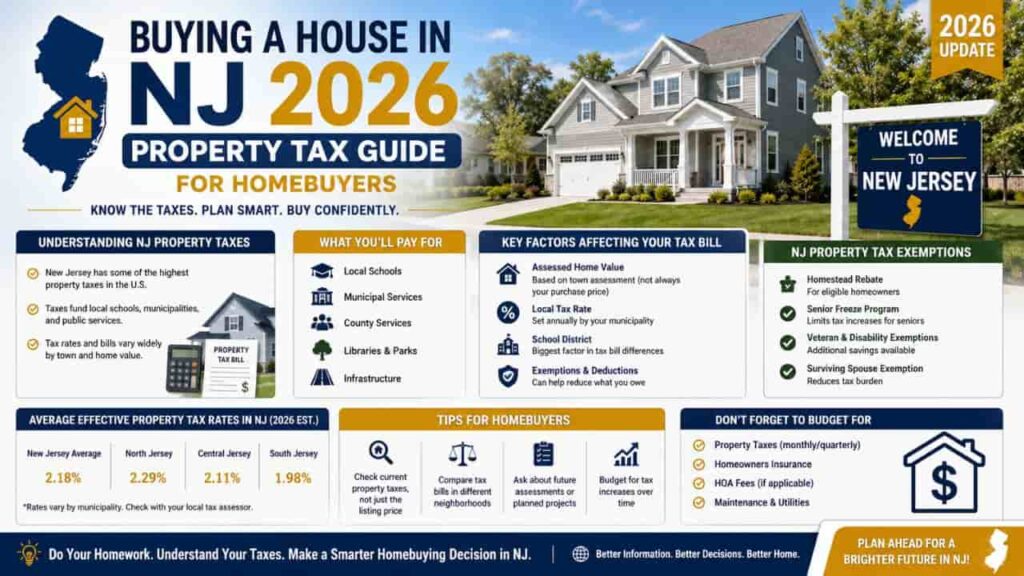
First Steps for New Jersey Homebuyers with Pre Purchase Strategy
If you are planning to buy a home(house) in New Jersey, your first and most critical step is to verify the official property tax record and the most recent assessment notice before falling in love with a listing. Because New Jersey carries the highest tax burden in the nation, the “estimated taxes” shown on real estate apps can be dangerously inaccurate, especially if the town is due for a revaluation. You should contact the local municipal tax assessor to confirm the current ad valorem tax rate and check if there are any pending bulk reassessments that could trigger a sudden spike in your quarterly payments after closing. Completing this due diligence ensures that your debt to income (DTI) ratio remains stable and that your dream home stays truly affordable.
New Jersey property taxes are calculated using an ad valorem system, where the tax amount is based on the assessed value of the real estate as determined by local municipal assessors. Because New Jersey has the highest property taxes in the United States averaging an effective rate of 2.23% understanding the specific financial obligations and state mandated forms is essential for any homebuyer or seller.
Understanding Buyer and Seller Tax Responsibilities
In New Jersey, the financial responsibilities at the time of a home sale are split between the buyer and the seller through specific fees and tax requirements.
The Realty Transfer Fee (RTF)
- Seller Responsibility. Sellers are generally responsible for paying a 1% Realty Transfer Fee on all home(house) sales at the time of closing.
- Buyer “Million Dollar” Fee. While the seller pays the standard RTF, buyers must pay an additional 1% fee on home purchases that exceed $1 million.
- Sales Tax Exemption. It is important to note that New Jersey does not charge Sales Tax on home sales.
GIT/REP Forms and Estimated Tax Payments
A GIT/REP form (Gross Income Tax Required Estimated Payment) must be recorded with the deed for every property transfer in New Jersey.
- Resident Sellers.
Residents who maintain their New Jersey residency after the sale file Form GIT/REP-3, which exempts them from making an estimated tax payment at closing. - Nonresident Sellers.
Nonresidents are typically required to pay an estimated tax at closing either 2% of the sales price or 8.97% of the net gain using Form GIT/REP-1. - Prepayment Option.
Nonresidents who wish to pay before the closing can use Form GIT/REP-2 and bring the stamped receipt to the settlement.
Step by Step Guide to NJ Property Tax Relief Programs
New Jersey offers several programs to help resident homeowners manage the high cost of property taxes on their principal residences.
Step 1. Determine Eligibility for the ANCHOR Program
The ANCHOR Program (which replaced the Homestead Benefit) provides property tax relief to New Jersey residents who owned or rented their principal residence on a specific date.
- Filing Requirement.
Applicants must file for the home they owned and occupied on October 1st of the application year. - Moving Considerations.
If you move after the qualification date, you must indicate the move on your application to ensure you receive the benefit directly rather than it being applied to the property’s new owners.
Step 2. Apply for the Senior Freeze (PTR)
The Senior Freeze program reimburses eligible senior citizens and disabled persons for property tax increases on their principal residence.
- Base Year.
The program establishes a “base year” of taxes, and any amount paid above that year is reimbursed annually. - New Home Exception.
If you move to a new principal residence in NJ, you must typically wait three years to establish a new base year, unless you were already in the program at your previous home, which may reduce the wait to two years.
Step 3. Claim Local Property Tax Deductions
Beyond state programs, New Jersey residents may qualify for local deductions managed at the municipal level.
- Veterans. An annual deduction is available for honorably discharged veterans.
- Disabled Veterans. A 100% Property Tax Exemption is available for veterans with a 100% permanent and total service connected disability.
- Seniors/Disabled Persons. An annual $250 deduction is available for low income seniors or disabled persons.
Quarterly Tax Schedules and Homeowner Management
Properly managing the timing of payments is critical for New Jersey homeowners to avoid interest penalties.
Quarterly Payment Dates
Property taxes in New Jersey are paid four times per year.
- February 1st
- May 1st
- August 1st
- November 1st
Escrow and Monthly Budgeting
Because New Jersey’s effective tax rates often exceed 2.2% (and can top 3% in high tax counties like Camden or Gloucester), most lenders require an escrow account. This account collects a portion of the annual tax bill each month as part of the mortgage payment to ensure funds are available for the quarterly deadlines.
Summary of Key NJ Real Estate Taxes and Fees
| Tax/Fee | Responsibility | Rate/Amount |
| Realty Transfer Fee (RTF) | Seller | 1% of sales price |
| Buyer Transfer Fee | Buyer | 1% on sales over $1M |
| Nonresident Estimated Tax | Nonresident Seller | 2% of price or 8.97% of gain |
| Sales Tax | N/A | 0% on home sales |
| Senior/Disabled Deduction | Homeowner | $250 annually (if eligible) |
The Property Tax Appeal Process
If a homeowner believes their property has been over assessed compared to current market values, they have the right to file an appeal.
How to File an Appeal
- Deadline.
Most appeals must be filed by April 1st with the County Board of Taxation. - Bulk Revaluation.
If a municipality performs a town wide reassessment, homeowners have 45 days from the date of the bulk notice to file an appeal. - Evidence. Successful appeals generally require providing “comparable sales” of similar homes in the area that sold for less than the property’s assessed value.
Closing Checklist for NJ Residents and Nonresidents
Ensuring the correct paperwork is filed at the time of title transfer is essential for recording the deed.
- GIT/REP-3. For residents to certify exemption from estimated tax payments.
- GIT/REP-1. For nonresidents to declare and pay estimated taxes.
- RTF-1. The Affidavit of Consideration, required by most sellers to record the deed and pay the transfer fee.
- GIT/REP-4. A waiver form for unique transactions that are exempt but do not fit the categories on the standard GIT/REP-3 form.
Conclusion
Successfully buying a home in New Jersey requires a clear understanding of the state’s 2.23% average effective tax rate, the highest in the nation. By understanding the ad valorem calculation multiplying your assessed value by the local composite rate you can accurately predict your quarterly financial obligations. Utilizing relief programs like ANCHOR or Senior Freeze, and performing diligent research via municipal tax records before closing, ensures your investment remains sustainable and protected in the competitive 2026 real estate market.
FAQs
How do I find the official tax history of a home in NJ?
You should visit the official NJ Property Tax Records website or the specific municipal tax portal to see the actual multi year trend of payments rather than relying on real estate listings.
What is the “Million Dollar” fee for New Jersey homebuyers?
Buyers purchasing a residential property for more than $1 million must pay a supplemental 1% fee at closing, which is separate from the standard Realty Transfer Fee paid by sellers.
What is the difference between market value and assessed value?
Market value is what you pay for the home, while assessed value is the figure placed on the property by the municipal assessor to calculate taxes; these two numbers often differ significantly.
When are property tax payments due in New Jersey?
Payments are due quarterly on February 1, May 1, August 1, and November 1. Late payments typically incur heavy interest penalties from the municipality.
How does the ANCHOR program help New Jersey homeowners?
The ANCHOR program provides direct property tax relief to eligible residents based on income levels, though you must live in the home as your principal residence to qualify.
Can I appeal my property tax assessment if it is too high?
Yes, you can file a formal appeal with the County Board of Taxation by April 1st (or within 45 days of a bulk reassessment notice) if you can prove your home is over assessed.
Does New Jersey tax VA disability benefits or home sales?
New Jersey does not charge Sales Tax on home sales, nor does it tax VA disability benefits, which helps protect the income of disabled veterans.
What happens during a municipal tax revaluation?
A town wide revaluation updates all property assessments to match current market prices. This can result in a significant tax increase if your property’s value has risen faster than the town average.