Receiving a “Notice of Violation” from your local New Jersey municipality is a high stress event that requires immediate, strategic action. In the Garden State, zoning enforcement is rigorous, and ignored citations can lead to mounting daily fines, municipal court appearances, and even liens against your property title. For New Jersey property owners, understanding the Municipal Land Use Law (MLUL) is the first step toward resolution. Whether you are dealing with an illegal apartment, a fence setback issue, or an unpermitted commercial use in a residential zone, most problems have a structured legal remedy. This professional guide deconstructs the most frequent zoning infractions and provides a step by step roadmap to achieving compliance in 2026.
The Most Frequent Zoning Infractions in New Jersey
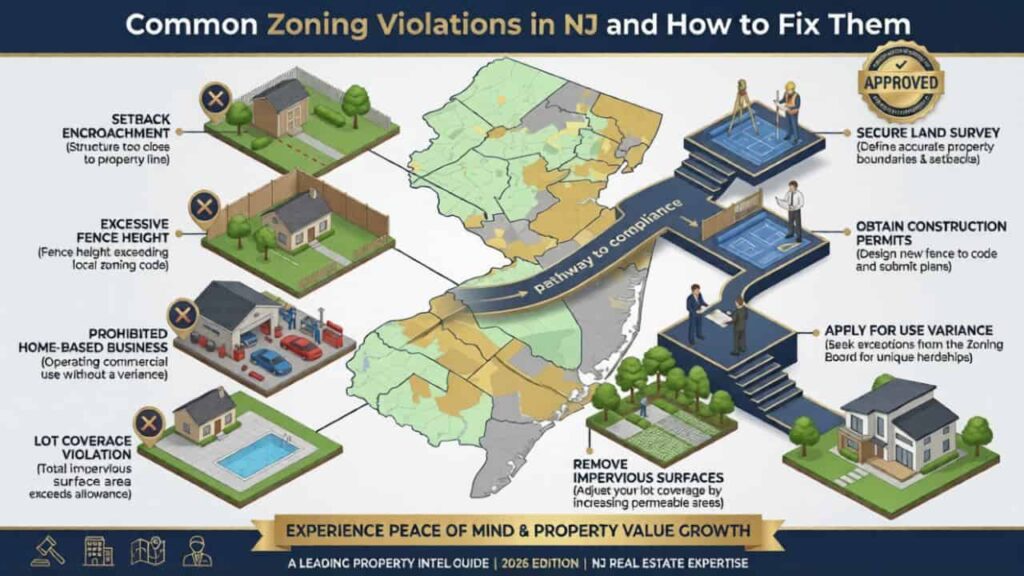
Zoning violations generally fall into two categories, Use Violations (what you are doing on the land) and Bulk Violations (where things are located on the land).
Common Violation Matrix
| Violation Type | Description | Typical Penalty |
| Illegal Conversions | Turning a basement, attic, or garage into a rental unit without approval. | Immediate “Cease and Desist” and potential tenant relocation costs. |
| Setback Encroachments | Building sheds, decks, or additions too close to the property line. | Requirement to move or demolish the structure. |
| Unpermitted Signage | Installing commercial signs that exceed size or illumination limits. | Daily fines until the signage is removed or modified. |
| Home Business Overreach | Running a business that attracts excessive traffic or noise in a residential zone. | Municipal court summons and business shut down orders. |
The Hidden Danger, Illegal Apartments and Conversions
In 2026, New Jersey’s housing shortage has led to a surge in illegal “mother daughter” setups or basement apartments. While Accessory Dwelling Units (ADUs) are becoming more popular, they must be legally registered.
If you are caught with an illegal rental.
- Safety Inspections.
The Fire Marshal and Building Inspector will likely conduct a mandatory safety audit. - Relocation Responsibility.
Under New Jersey state law, if a tenant is evicted due to an illegal zoning occupancy, the landlord is often responsible for paying the tenant’s relocation expenses (often equivalent to six times the monthly rent). - Legalization.
You may be required to apply for a Use Variance (D-Variance), which is a complex legal process requiring a hearing before the Zoning Board.
The Power of the Zoning Verification Letter
One of the most underutilized tools for New Jersey property owners is the Zoning Verification Letter (ZVL). This is an official document issued by the Municipal Zoning Officer that confirms the current legal status of a property’s use and structures.
Why You Need a Zoning Verification Letter
- During a Sale. It proves to a buyer’s title company that there are no outstanding violations.
- Refinancing. Lenders often require a ZVL to ensure the property is “conforming” to local laws.
- Disputing a Violation. If a neighbor reports you for an illegal use, a ZVL issued in the past can serve as your primary defense.
- Commercial Due Diligence. For business owners, it verifies that your specific industry is permitted at that specific address.
Step by Step Guide, How to Fix a Zoning Violation
If you have already received a summons or a violation notice, do not panic. Follow this professional sequence to resolve the issue.
Step 1. The Information Gathering Phase
Request a meeting with the Zoning Officer to clarify the exact ordinance you have violated. Do not offer more information than necessary; simply listen to the specific “code section” cited.
Step 2. Request a Zoning Verification Letter
If you believe your property was “Grandfathered” (a Non Conforming Use), search your records for old permits or apply for a ZVL to see if the town acknowledges the use as pre existing.
Step 3. Evaluate the “Cure” vs “Variance”
- The Cure
If your shed is 2 feet over the line, the “cure” is simply moving it. This is usually the cheapest and fastest route. - The Variance
If moving the structure is impossible, you must file an application for a Variance. This is a request to be “excused” from the law. You will need to prove that the deviation does not negatively impact the “Public Good” or the “Zoning Plan.”
Step 4. The Public Hearing (If Required)
For variances, you must notify all neighbors within 200 feet via certified mail. You will then present your case to the Zoning Board of Adjustment.
Table with Costs and Timelines for Resolution
| Action | Estimated Cost | Estimated Timeline |
| Zoning Verification Letter | $50 – $150 | 5 to 10 Business Days |
| Bulk Variance (C Variance) | $1,500 – $5,000 (inc. fees/legal) | 3 to 6 Months |
| Use Variance (D Variance) | $5,000 – $15,000+ | 6 to 12 Months |
| Permit Retrofitting | Varies by project | 1 to 2 Months |
Conclusion
In the complex landscape of New Jersey real estate, a zoning violation is a cloud on your title that can devalue your asset overnight. The most effective way to protect your investment is through proactive verification. Whether you are purchasing a new property or renovating an existing one, obtaining a Zoning Verification Letter is the ultimate insurance policy. If you find yourself in receipt of a violation notice, move quickly to consult with a zoning professional or the municipal officer; in 2026, early communication is the only way to avoid the crushing weight of municipal litigation and daily fines.
FAQs
What is the difference between a building violation and a zoning violation in NJ?
A building violation relates to safety codes (UCC), like bad wiring. A zoning violation relates to the location or use of the property, such as building too close to the property line.
Can I get “Grandfathered” into a zoning violation?
Only if you can prove the use or structure existed before the current ordinance was passed. This is known as a “Legal Non Conforming Use.”
How do I get a Zoning Verification Letter in NJ?
You must submit a written request to the Municipal Zoning Officer, usually accompanied by a small fee. Some towns have a specific form on their website.
What happens if I ignore a zoning summons in New Jersey?
Ignoring a summons can lead to an arrest warrant, daily fines (sometimes $500–$2,000 per day), and a permanent lien placed on your property.
Can a neighbor report me for a zoning violation?
Yes. In New Jersey, many zoning investigations are “complaint based,” meaning they are triggered by a neighbor calling Town Hall.
Do I need a lawyer for a Zoning Board hearing?
If the property is owned by an LLC or Corporation, New Jersey law requires you to be represented by an attorney. Individual homeowners can represent themselves, but an attorney is highly recommended for D Variances.
How do I fix a setback violation for a deck?
You can either trim/modify the deck to meet the required distance or apply for a C-Variance based on the “hardship” of the land’s shape.
Is an “In law suite” a zoning violation?
It is a violation if it contains a full kitchen and is located in a zone restricted to “Single Family Residential” without an ADU permit.
What is a “Notice of Abatement”?
This is a legal order telling you that you have a specific number of days (usually 10–30) to fix the violation before fines begin to accrue.
Can I sell a house with open zoning violations?
It is extremely difficult. Most buyers’ attorneys and title companies will require all violations to be “closed out” or “abated” before they allow the closing to proceed.