In the post pandemic evolution of the Garden State, the line between “where we live” and “where we work” has effectively vanished. For the savvy investor, this shift represents the most significant “buy” signal in a decade. New Jersey’s Municipal Land Use Law (MLUL) has paved the way for a resurgence in Mixed Use Development, turning underutilized commercial corridors into high yield, live work play hubs. However, in New Jersey, zoning is not a suggestion it is a rigid legal framework. Success in 2026 requires more than capital; it requires regulatory intelligence. This guide audits the best towns for mixed use investment and breaks down the commercial zoning laws you must understand to secure your entitlements.
The 2026 Shift, Why Mixed Use is the Investor’s Gold Mine
Mixed use zoning (typically designated as MXD or B-1/Residential in local codes) allows for multiple uses within a single structure or on a single tax lot. Traditionally, this means “retail on the ground, luxury rentals above.”
The Strategic Advantage for Investors
- Risk Diversification.
If the retail market dips, residential rents provide a hedge, and vice versa. - Higher Density Allowances.
Towns like Newark and Jersey City offer “Density Bonuses” for mixed use projects that include affordable housing units. - Transit Oriented Development (TOD).
2026 legislation incentivizes building near NJ Transit hubs, often reducing mandatory parking ratios a major cost saver.
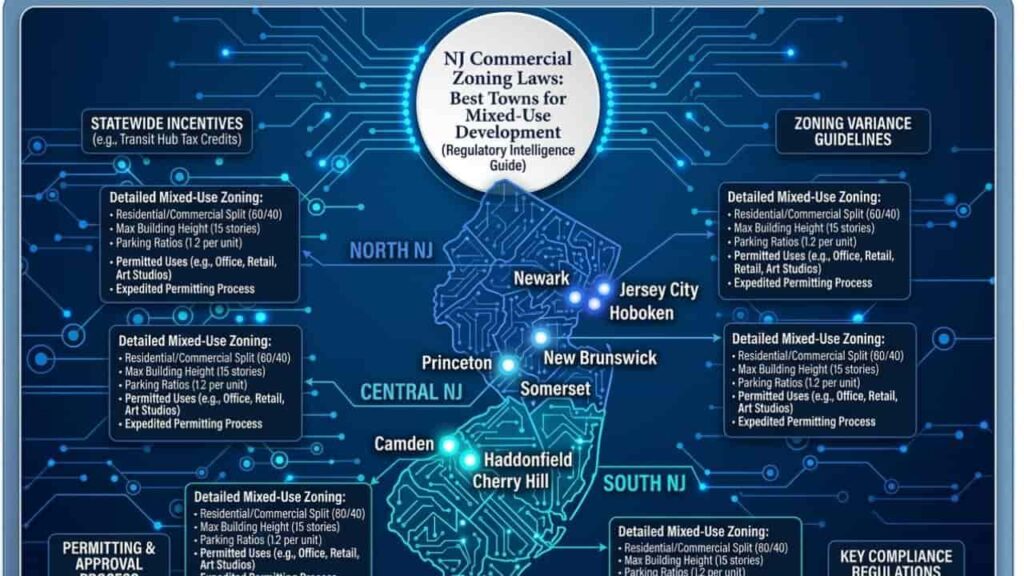
Top NJ Towns for Mixed Use Development in 2026
Not all municipalities are created equal. Some NJ towns have “Friendly Zoning,” while others maintain restrictive “Home Rule” policies that can stall a project for years.
Investment Hotspots Matrix
| Municipality | Primary Zoning District | Investor Incentive |
| Jersey City | Journal Square 2060 | High density allowances with zero minimum parking in certain zones. |
| Newark | MX-3 (High Intensity) | Significant tax abatements (PILOT programs) for urban core revitalization. |
| Asbury Park | Waterfront Redevelopment | Rapid appreciation and streamlined “Redevelopment Area” permitting. |
| Montclair | C-1 (Central Business) | High demand for “boutique” mixed use; strong retail absorption rates. |
Understanding NJ Commercial Zoning Laws, Technical Requirements
Before signing a Letter of Intent (LOI), you must perform a “Zoning Audit” based on the Municipal Land Use Law. Here are the three pillars of commercial development in New Jersey.
1. Permitted Uses vs. Conditional Uses
A Permitted Use is allowed “as of right.” If your project fits the zone, the Zoning Officer must issue a permit. A Conditional Use (N.J.S.A. 40:55D-67) is only allowed if you meet specific “if then” scenarios, such as extra landscaping or a specific distance from schools.
2. The Bulk Requirements (The “Box”)
Commercial zoning dictates the physical “envelope” of your building.
- Floor Area Ratio (FAR).
The ratio of total building floor area to the size of the lot. A higher FAR allows for more “rentable square footage.” - Impervious Coverage.
NJDEP regulations are strict in 2026; you must account for stormwater management if your building and parking cover more than a specific percentage of the lot. - Setbacks.
Commercial buildings in urban centers often have “zero lot line” setbacks, allowing the building to touch the sidewalk, which is ideal for retail visibility.
3. Parking Ratios, The Project Killer
In suburbs like Cherry Hill or Paramus, parking requirements can destroy a mixed use project.
- Retail Requirement. Often 4 to 5 spaces per 1,000 sq. ft.
- Residential Requirement. Often 1.5 to 2 spaces per unit (governed by the Residential Site Improvement Standards – RSIS).
Tip. In 2026, many urban zones allow for Shared Parking Agreements, where retail spaces (used by day) and residential spaces (used by night) share the same stalls.
Step by Step, From Raw Land to “Certificate of Occupancy”
To ensure your project doesn’t get un indexed by market shifts or regulatory hurdles, follow this expert sequence.
Step 1. The Concept Meeting
Schedule a “Pre Technical” meeting with the town’s Planning Board Secretary. Present a sketch. If your project needs a Use Variance (D-Variance), you are looking at a much higher legal hurdle.
Step 2. Environmental Due Diligence
NJ commercial lots often have “Legacy Issues.”
- Phase I & II ESA. Mandatory to check for soil contamination.
- ISRA Compliance. If the lot was previously an industrial site, you must clear the Industrial Site Recovery Act protocols.
Step 3. Site Plan Approval
Unlike a single family home, commercial mixed use requires Preliminary and Final Site Plan Approval.
- Public Hearing.
You must notify neighbors within 200 feet via certified mail. - Expert Testimony.
You will need a licensed NJ Engineer, Architect, and often a Professional Planner to testify that your project benefits the town’s Master Plan.
The 2026 Regulatory Environment, New Rules to Watch
The New Jersey Legislature has introduced several “Business Friendly” updates for 2026 that every investor should capitalize on.
- EV Charging Mandates.
New mixed use projects must now designate a specific percentage of parking as “Make Ready” for Electric Vehicle Charging Stations. - Stormwater Management 2.0.
Green infrastructure (rain gardens, pervious pavers) is no longer optional for major developments. - Affordable Housing Obligations.
With the 2026 “Fourth Round” of Mt. Laurel obligations, mixed use developers may find more towns willing to grant Density Bonuses in exchange for set aside units.
Conclusion
Mixed use development in New Jersey is a high barrier to entry game, but that barrier is exactly what protects your investment’s value. By targeting towns like Newark or Jersey City that actively use their Zoning Maps to promote growth, you align your capital with the town’s future. Success in this sector is 20% construction and 80% understanding the Municipal Land Use Law. Before you break ground, ensure your “Land Use Team” your attorney, engineer, and planner has vetted every inch of the local code. In NJ, a single parking space or a two foot setback violation can be the difference between a “Yes” and a “No” from the Board.
FAQs
What is the most investor friendly zoning for mixed use in NJ?
The MXD (Mixed Use District) and TOD (Transit Oriented Development) zones are typically the most lucrative. These areas allow for higher density and reduced parking requirements, especially near NJ Transit hubs in cities like Jersey City and Newark.
How does the 2026 “Fourth Round” affordable housing affect mixed use?
Under the latest Mt. Laurel obligations, municipalities are incentivized to grant Density Bonuses to developers who include affordable housing units within their mixed use projects. This allows investors to build more units than standard zoning typically permits.
Can I convert an existing office building into mixed use residential in NJ?
Conversion usually requires a Use Variance (D-1) if the current zone does not explicitly allow residential dwelling. However, many NJ towns are currently updating their Master Plans to allow “Adaptive Reuse” of vacant commercial spaces “as of right”.
What are “PILOT” programs in NJ commercial development?
PILOT (Payment In Lieu Of Taxes) programs are financial incentives often found in Redevelopment Areas like Newark. They allow developers to pay a fixed annual fee instead of traditional property taxes, significantly improving the project’s long term cash flow.
Do mixed use projects require separate parking for retail and residents?
While the RSIS (Residential Site Improvement Standards) dictates residential parking, many urban NJ zones now allow Shared Parking Agreements. This recognizes that retail parking (daytime use) and residential parking (nighttime use) can utilize the same spaces.
What is the role of the NJDEP in commercial zoning?
Even if local zoning allows a build, the NJDEP (New Jersey Department of Environmental Protection) may restrict it through Stormwater Management rules or Flood Hazard Area permits. Environmental “clean letters” (LSRP oversight) are often a prerequisite for financing.
How much is the application fee for a commercial site plan in NJ?
Application fees vary by municipality but generally range from $500 to $2,500+, plus an Escrow Deposit (often $5,000–$15,000) used to pay the town’s professional engineers and attorneys for their review.
What is a “Zero Lot Line” in urban NJ development?
Common in cities like Hoboken or Jersey City, this allows a commercial or mixed use building to be constructed right up to the property line (sidewalk), maximizing the building’s footprint and retail visibility.
How do I verify if a lot is in a “Redevelopment Area”?
You must check the municipality’s Official Zoning Map or contact the Planning Department to see if a Redevelopment Plan has been memorialized for that specific block and lot. Redevelopment areas offer much more flexible zoning than standard districts.
Why is “Floor Area Ratio” (FAR) important for NJ investors?
FAR determines the total square footage you can build relative to the land size. A higher FAR allows for more rentable or sellable space, which is the primary driver of a mixed use project’s ROI (Return on Investment).