In New Jersey’s high-stakes real estate landscape, “ownership” does not equate to “entitlement.” Whether you’re eyeing a ground-up build in Medford or a high-density addition in Jersey City, your project’s viability is strictly dictated by the Municipal Land Use Law (MLUL) and hyper-local zoning ordinances. Navigating these regulations requires more than a cursory glance at a map; it demands a strategic analysis of bulk requirements, setbacks, and 2026’s evolving ADU mandates. This expert guide provides the professional framework necessary to audit your lot’s buildability, mitigate regulatory risk, and maximize your property’s highest and best use.
The Golden Rule of NJ Zoning: Verify Before You Design
Before hiring an architect or contractor, you must confirm the legal classification of your block and lot. Every New Jersey municipality has a specific zoning map and a “Schedule of Requirements” that dictates the physical limits of your property.
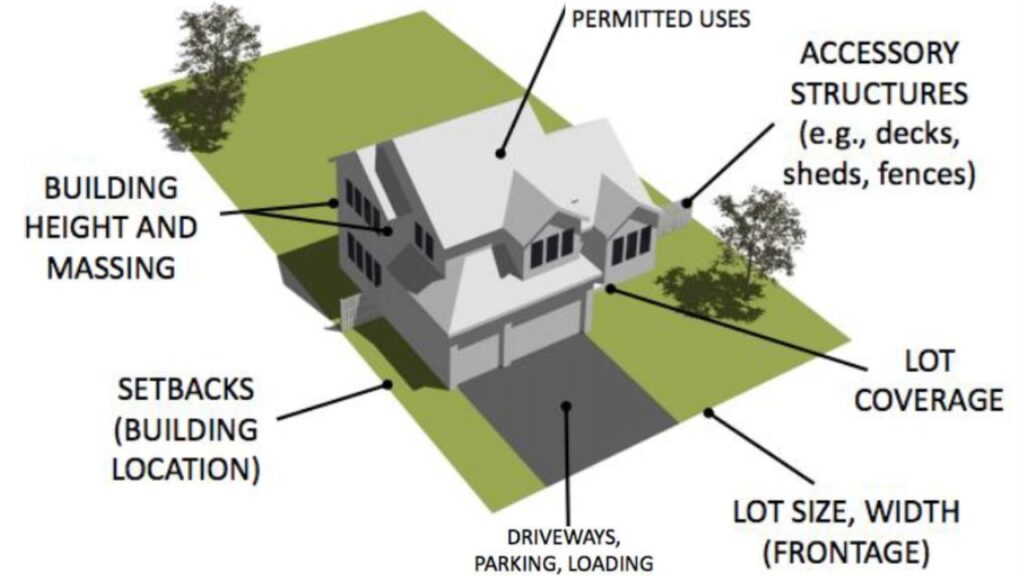
Critical Zoning Constraints for Residential Lots:
- Permitted Property Use:
Does your zone allow single-family, multi-family, or mixed-use development? - Setbacks:
The mandatory “clearance” distance from the front, side, and rear property lines. For example, in Avalon, cantilevered sections of a building must still fall within the “buildable area”. - Lot Coverage (Impervious Surface):
The percentage of your lot that can be covered by structures, driveways, and patios. Exceeding this limit is a leading cause of permit denials. - Building Height:
Usually measured from the finished grade to the highest peak of the roof.
2026 Residential Development Standards in NJ
New Jersey towns use standardized codes to manage density. Below is a professional reference table for common residential accessory structures and their requirements.
Professional Residential Zoning Matrix
| Structure Type | Common Height Limit | Common Setback Requirements | Key Restriction |
| Private Garage | 15–20 feet | 10–25 feet (varies by district) | Limit of 1-2 per lot depending on acreage. |
| Shed / Accessory Bldg | 12–15 feet | 5–10 feet for small structures | Max size often capped at 200–400 sq. ft.. |
| Fences | 4ft (Front) / 6ft (Rear) | Usually on property line | Finished side must face out (common town rule). |
| Attached Decks | N/A (Matches Primary) | Cannot occupy yard setbacks | Must be at least 8 inches above grade. |
The Rise of ADUs: New Opportunities in 2026
As of 2026, New Jersey has seen a massive shift toward “Missing Middle” housing. Under the “Desegregate New Jersey Act” (S2889) and related legislation, many municipalities are now required to permit Accessory Dwelling Units (ADUs) like “granny flats” or garage apartments on single-family lots.
Standardized ADU Requirements (Statewide Targets):
- Floor Area: Typically between 300 and 1,200 square feet.
- Height: Minimum height allowance of at least 20 feet.
- Approval Time: Municipalities must generally decide on ADU applications within 60–65 days.
Step-by-Step: Testing Your Lot’s Buildability
If you are buying land or planning a major redevelopment, follow this professional “Due Diligence” checklist.
- Request a Zoning Determination Letter (ZDL):
In towns like Jersey City, this is the first step to confirm if your proposed use is legal. - Order a Topographical Survey:
Zoning is often calculated based on “Steep Slopes.” In some NJ towns, lot coverage is reduced significantly if your land has a slope greater than 10%. - Perform a Percolation (“Perc”) Test:
If your lot is not on a public sewer line, you cannot build a home without a passing septic test. - Check for “Landlocked” Status:
Ensure your lot has a recorded access easement or frontage on a public road.
Navigating the Zoning Board: When to Apply for a Variance
If your lot is too small or your project slightly exceeds lot coverage, you must apply for a Variance through the local Zoning Board of Adjustment. This process is public and requires notifying neighbors within 200 feet.
Expert Insight: “C” Variances (Bulk) are common for setback issues on odd-shaped lots. “D” Variances (Use) are much more difficult and require proving “Special Reasons” to the board.
MUNICIPAL LAND USE LAW PDF
Final Checklist for Success:
- Confirm zoning permissions before making an offer.
- Check for environmental buffers like wetlands or flood zones.
- Ensure legal road access and utility capacity exist.
Conclusion
In New Jersey’s high-stakes residential market, “buildability” is a moving target dictated by the Municipal Land Use Law (MLUL) and evolving density mandates. Success requires more than a standard survey; it necessitates a strategic audit of bulk requirements, impervious coverage limits, and environmental overlays. By prioritizing front-end due diligence and engaging a specialized land-use team, you insulate your capital from the 2026 regulatory shifts that often derail unoptimized projects. In the Garden State, professional foresight is the only true hedge against development risk.
FAQs
Can I build a second home or ADU on my residential lot in NJ?
Under the Municipal Land Use Law (MLUL) and recent 2026 housing reforms, many NJ municipalities are now required to permit Accessory Dwelling Units (ADUs) on single-family lots. However, building a second “principal” dwelling typically requires a subdivision or a specific multi-family zoning designation.
How do I determine the maximum building height for my NJ property?
Building height is defined in your town’s Schedule of Requirements. Most NJ towns measure height from the average finished grade to the highest ridge of the roof, though coastal towns like Avalon or Ocean City may have specific “Freeboard” requirements based on flood elevation.
What is the difference between “Lot Coverage” and “Building Coverage”?
Building Coverage refers only to the footprint of the house and accessory buildings. Lot Coverage is broader and includes all impervious surfaces such as driveways, patios, and swimming pool surrounds. Exceeding lot coverage is a common reason for permit denials in New Jersey.
How close to the property line can I build a shed or garage?
This is governed by accessory structure setbacks. While a primary residence might require a 25-foot rear setback, a small shed (under 200 sq. ft.) may only require a 5 to 10-foot setback depending on your specific NJ residential zone.
Do I need a variance to build on an “undersized” lot in NJ?
If your lot does not meet the minimum area requirements of the current zoning map, it is considered “non-conforming”. You may need a “C” Variance (Bulk Variance) from the local Zoning Board of Adjustment to prove that the lot’s unique physical characteristics justify a deviation from standard rules.
How do wetlands or flood zones affect my building permits?
In New Jersey, state-level NJDEP (New Jersey Department of Environmental Protection) regulations often override local zoning. If your lot contains wetlands or falls within a Flood Hazard Area, you must obtain NJDEP “Letter of Interpretation” (LOI) or specific permits before municipal construction can begin.
Can I convert my garage into a living space in New Jersey?
Converting a garage requires a Zoning Permit to ensure you still meet the town’s minimum off-street parking requirements. If the conversion reduces your parking below the legal limit, you may be forced to apply for a variance.
What are “Setbacks” and how are they measured in NJ?
Setbacks are the mandatory open spaces between a building and its property lines. They are categorized as Front, Side, and Rear setbacks. In many NJ towns, “Front Setbacks” are measured from the street’s “Right of Way” rather than the curb line, which can significantly impact your buildable area.