In New Jersey, the law of Caveat Emptor (Buyer Beware) means that once you close on a property, you inherit every municipal violation and unpermitted renovation attached to it. A sleek, modern kitchen might look perfect, but if it was built without a permit, the local building department could force you to tear it down at your own expense. To mitigate this risk, sophisticated players in the New Jersey market utilize the Open Public Records Act (OPRA). This legislation grants you the legal right to access government records, allowing you to see exactly what the town knows about a property before you commit your capital.
1. What is an OPRA Request?
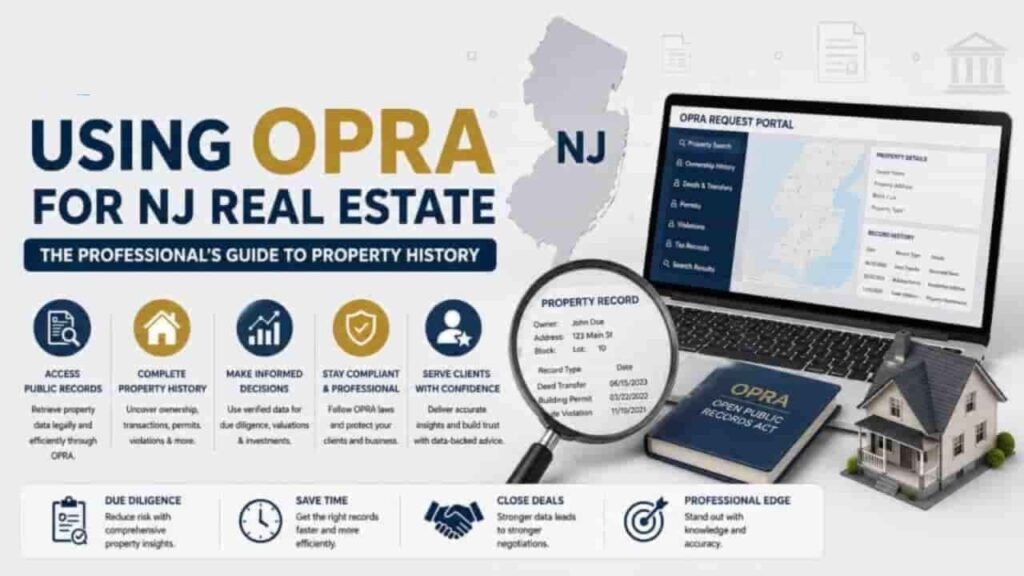
The Open Public Records Act is a New Jersey statute that provides the public with a mechanism to access government records maintained by public agencies. In the context of real estate, this allows you to bypass marketing fluff and look at the official paper trail filed with the Township Clerk, Construction Department, and Board of Health.
Why Standard Searches Aren’t Enough.
- Title Searches. Only show financial liens, mortgages, and legal judgments.
- Home Inspections. Only show the current physical condition, not whether that condition is legally permitted.
- OPRA Requests. Reveal “hidden” history like expired permits, underground oil tanks, and zoning variances.
2. Strategic Data Extraction, What to Request
To perform professional grade due diligence, your OPRA request must be surgical. Requesting “all records” is often too broad and leads to delays. Instead, you should target specific departments based on the property type.
Municipal Data Mapping for 2026
| Department | Critical Document to Request | Why It Matters for Buyers |
| Construction | Open and Closed Permits; Certificates of Occupancy (CO) | Ensures all renovations (decks, basements, kitchens) are legal. |
| Health/Fire | Underground Storage Tank (UST) records; Septic approvals | Identifies environmental hazards like leaking oil tanks or failing septics. |
| Zoning/Land Use | Variance approvals; Setback requirements; Violations | Confirms the property can be used for your intended purpose (e.g., adding a pool). |
3. Step by Step, How to File a Professional OPRA Request
In 2026, the process of filing an OPRA request in New Jersey has been streamlined through digital portals. Here is the workflow used by real estate experts.
Step 1. Identify the Custodian
Every municipality has a Custodian of Records, typically the Municipal Clerk. Visit the official township website (e.g., middletownnj.org or cherryhill nj.com) and look for the “OPRA” or “Clerk” section.
Step 2. Use Precise Legal Language
Your request must be specific. Do not ask questions; instead, ask for specific records.
- Weak Request. “Is the basement finished legally?”
- Expert Request. “I am requesting copies of all construction, electrical, and plumbing permits, including initial applications and final inspections/approvals, for Block [X], Lot [Y] from [Year] to the present.”
Step 3. The 7 Day Timeline
Under NJ law, the custodian has 7 business days to grant or deny access. If the records are archived or require significant redaction, they may request an extension, but they must provide a specific date for fulfillment.
Step 4. Review for “Open” Permits
An “Open” permit means work was started but never passed a final inspection. In New Jersey, an open permit can prevent you from obtaining a mortgage or a new Certificate of Occupancy when you try to sell the home later.
4. Identifying “Red Flags” in the Property History
When you receive your OPRA results, you need to look for discrepancies between the physical house and the official records.
- The “Ghost” Renovation. The house has a finished basement, but the OPRA results show no permits filed for basement work. This is a major liability.
- The Missing Tank Sweep. If the house was built before 1975, look for records of oil tank removals. If the town has no records but you see a patch in the driveway, there may be a “zombie” tank underground.
- Expired Variances. If the seller claims you can build an addition, verify the zoning board records. A variance granted to a previous owner may have expired.
5. Professional Checklist for 2026 Due Diligence
Ensure your investigation covers these five high risk areas.
- Certificate of Occupancy (CO).
Verify the original CO matches the current use of the home (e.g., a 2 family home must be registered as such). - Environmental History.
Check for “No Further Action” (NFA) letters from the NJ Department of Environmental Protection (DEP). - Tax Assessment Card.
Compare the “livable square footage” on the tax card to the actual house size. - Code Enforcement.
Check for active maintenance violations or “Notice of Unsafe Structure” filings. - Utility Records.
For properties with municipal water/sewer, check for unpaid “connection fees” which can be thousands of dollars.
6. Expert Verdict, When to File the Request
The most critical mistake buyers make is waiting until the end of the transaction to file an OPRA.
Tips. File your OPRA request during the Attorney Review period. If you discover a massive zoning violation or an illegal addition on Day 3, you have the legal leverage to cancel the contract or force the seller to remediate the issue before you are fully “under contract.”
Conclusion
In the 2026 New Jersey property market, what you don’t know can hurt your investment. While a standard home inspection and title search are non negotiable, the Open Public Records Act (OPRA) is your secret weapon for uncovering the “invisible” history of a property. By proactively requesting permit histories, environmental reports, and zoning records during your due diligence period, you transform from a passive buyer into an informed investor. Don’t leave your financial future to chance or rely solely on a seller’s disclosure. Use the steps outlined in this guide to verify the municipal integrity of your potential home. Whether it’s ensuring a basement renovation was done to code or confirming the removal of a historical oil tank, a strategically filed OPRA request provides the ultimate peace of mind.
FAQs
What is an OPRA request in New Jersey real estate?
An OPRA (Open Public Records Act) request is a legal tool in New Jersey that allows buyers to access official municipal property records, including permits, zoning history, and inspection reports for due diligence before purchasing real estate.
Why is OPRA important for New Jersey property buyers?
OPRA is essential in New Jersey real estate because it reveals hidden property issues such as unpermitted renovations, expired permits, zoning violations, and environmental risks that are not shown in standard home inspections or title searches.
What if the town has “No Records Found”?
This is a double edged sword. It means there are no active violations, but if the house has clearly been updated recently, “No Records” proves the work was done illegally without permits.
Does it cost money to file an OPRA in NJ?
In 2026, almost all municipalities provide digital files (PDFs) via email or portal download free of charge. Fees are typically only charged if you request physical paper copies ($0.05 per page) or if the request requires an extraordinary amount of labor.
Is my OPRA request private?
No. OPRA requests themselves are public records. The seller or their agent can see that a request was filed for their property, though this rarely affects the transaction.
How do I file an OPRA request in New Jersey?
To file an OPRA request in New Jersey, identify the municipal Clerk (Custodian of Records), submit a detailed request through the township’s OPRA portal, and clearly list Block and Lot numbers along with specific documents such as permits or inspection reports.
Can OPRA help avoid real estate investment risks in New Jersey?
Yes, OPRA is a powerful risk mitigation tool in New Jersey real estate investing because it exposes hidden liabilities, ensuring buyers make informed decisions and avoid costly municipal violations or unexpected renovation penalties.