For senior citizens and disabled homeowners in New Jersey, managing a fixed income while facing the nation’s highest property tax rates can be a severe financial challenge. Fortunately, the state’s Property Tax Reimbursement Program, universally known as the Senior Freeze (PTR), provides an incredibly powerful administrative shield. Rather than physically changing your local municipal assessment, this program establishes a baseline tax year and reimburses you for any subsequent property tax increases. With the state officially launching the consolidated property tax relief framework via Form PAS-1, understanding the updated 2026 income thresholds and foundational base year rules is essential to safeguarding your household budget.
The Historic Expansion of Senior Freeze Income Limits
To combat escalating inflation and keep more aging residents in their homes, New Jersey lawmakers enacted sweeping structural expansions to the Senior Freeze qualification framework. The historical income cap, which previously hovered just under $100,000, has been permanently elevated.
[Historical Income Limit] ➔ $100,000
[Updated Eligibility Pool] ➔ 2024. $168,268 Max | 2025: $172,475 Max
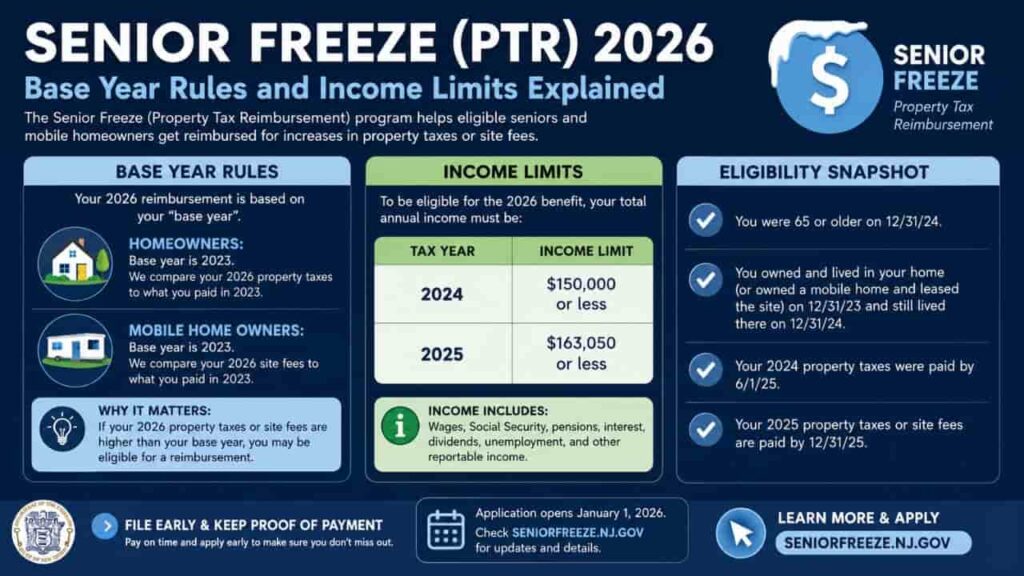
Because the Senior Freeze application process always looks backward at a two year structural window to establish a baseline, applicants filing their state documentation must verify their total gross income across consecutive cycles. To satisfy the explicit statutory guidelines administered under the state’s budget, your comprehensive gross income which includes your gross Social Security benefits, pension payouts, traditional IRA distributions, and earned capital gains must not cross the following caps.
| Fiscal Tracking Year | Official Gross Income Limit | Statutory Compliance Rule |
| Tax Year 2024 | $168,268 or Less | Your total household income from all taxable and non taxable sources must remain under this ceiling. |
| Tax Year 2025 | $172,475 or Less | The updated maximum limit used to determine eligibility for the current rolling reimbursement cycle. |
How the “Base Year” Mechanism Protects Your Equity
The core economic driver of the PTR program is the establishment of your personal Base Year. Your base year is the specific calendar year in which you successfully meet all statutory eligibility criteria, including age, residency duration, and income boundaries. Once your base year is officially locked by the New Jersey Division of Taxation, your property tax liability is effectively frozen at that specific dollar amount.
- The Freeze Process.
If your property tax bill during your established base year was $8,000, and your local municipality increases municipal, school, or county tax levies over the next few years until your bill hits $10,000, you are still required to pay the full $10,000 to your local tax collector. - The Reimbursement Solution.
The state will calculate the exact structural delta between your current bill and your locked base year amount ($10,000 to $8,000) and mail you a state check for the $2,000 difference.
What Happens if You Move?
It is critical to note that your base year is legally tied directly to your physical structural parcel—it does not follow you to a new house. If you sell your home and relocate to another township or downsize into a different property within New Jersey, your established tax freeze is completely erased. You must live in that new principal residence for the state mandated window before you can apply to establish a brand new base year at the new property’s current tax rate.
The Step by Step Senior Freeze Filing Protocol
The state has transitioned to a streamlined, multi program application form called Form PAS-1. This single unified document handles your Senior Freeze data, your ANCHOR rebate files, and the newer Stay NJ credit structures all at once.
1. Verify Age and Core Residency (Form PAS-1 Access)
Confirm your baseline parameters. You must be aged 65 or older by December 31, 2025 (born in 1960 or earlier), or be receiving federal Social Security disability benefits. You must have owned and lived in your primary home since at least December 31, 2022.
2. Audit Your Multi Year Income Metrics (No More Verification Forms)
Review your 2024 and 2025 NJ-1040 tax returns to ensure your gross incomes are below the $168,268 and $172,475 limits. Under the updated system rules, you no longer need to submit paper tax verification forms (like the old PTR-1A or PTR-2A) signed by your local collector.
3. File Electronically or via Mail via propertytaxrelief.nj.gov (Filing Before the Fall Deadline)
Submit your completed Form PAS-1 through the state’s secure online property tax relief portal or return the paper booklet via mail. Ensure your package is submitted before the state’s hard autumn filing deadline.
Understanding the Reimbursement Payment Schedule
Once your application has been formally processed and approved by the Division of Taxation, benefits are distributed on a highly predictable, rolling seasonal calendar. The state processes Senior Freeze payouts ahead of other relief initiatives like ANCHOR to ensure elderly residents receive their capital back as quickly as possible.
| Property Tax Relief Track | Initial Distribution Date | Dynamic Payment Delivery Channel |
| Senior Freeze (PTR) Payouts | July 15th | Begins issuing on a rolling basis, online filers can choose direct deposit, while paper filers receive a physical check. |
| ANCHOR Rebate Payments | September 15th | Distributed on a rolling basis, typically within 90 days of application approval. |
| Stay NJ Benefit Credits | Quarterly Schedule | Disbursed in structured increments to maximize long term housing affordability. |
The Advanced Multi Program Interaction Rule. Do not worry about your Senior Freeze reimbursement canceling out your other state benefits. Under current New Jersey Treasury guidelines, qualified senior citizens can legally stack the Senior Freeze, the ANCHOR rebate, and the Stay NJ benefit simultaneously. The state’s processing engine uses your Form PAS-1 inputs to compute your Senior Freeze check first, applies your ANCHOR credit second, and then utilizes the new Stay NJ formula to cover up to 50% of your remaining net tax liability (up to a fixed cap), maximizing your overall financial relief.
Conclusion
Maximizing your property tax relief through the Senior Freeze (PTR) program requires careful tracking of state income limits and strict adherence to the base year framework. Thanks to the expanded caps matching $168,268 for 2024 and $172,475 for 2025, tens of thousands of New Jersey seniors who were previously excluded are now fully eligible for protection. By leveraging the streamlined Form PAS-1 filing process, avoiding common baseline traps when moving, and verifying your rolling July 15th payment schedule, you can permanently neutralize escalating local property tax hikes and keep your hard earned equity secure.
FAQs
What is the income limit for the Senior Freeze in New Jersey?
For the current application cycle, your total gross income must have been $168,268 or less for 2024 and $172,475 or less for 2025.
Does Social Security count toward the Senior Freeze income cap?
Yes. New Jersey requires you to include all gross income sources, including your total Social Security benefits, pension distributions, and traditional IRA withdrawals.
What does “Base Year” mean in the Senior Freeze program?
Your base year is the initial year you qualify for the program. The state locks in your property tax amount from that year and reimburses future increases.
What is Form PAS-1 in New Jersey?
Form PAS-1 is the new, consolidated application that allows senior homeowners to apply for the Senior Freeze, ANCHOR, and Stay NJ programs simultaneously.
Do I still need my local tax collector to sign a verification form?
No. Under the updated streamlined system, applicants are no longer required to submit signed paper property tax verification forms with their application.
When do the Senior Freeze reimbursement checks start mailing out?
Official Senior Freeze reimbursement payments are scheduled to begin distribution on July 15th and continue on a rolling basis based on your filing date.
What happens to my Senior Freeze if I buy a new home in NJ?
Your tax freeze is tied strictly to your physical property. Moving to a new house resets the process, requiring you to establish a brand new base year.
Can I apply for the Senior Freeze if I live in a mobile home?
Yes. Homeowners who lease a site in a mobile home park and own their manufactured home are fully eligible to apply for PTR benefits.
Can an unmarried surviving spouse keep an established base year?
Yes. If a spouse passes away, the unmarried surviving spouse can legally maintain the established base year, provided they met the eligibility criteria when the partner died.
Can you combine Senior Freeze with the ANCHOR rebate program?
Yes. New Jersey explicitly allows you to stack both programs. Your Senior Freeze reimbursement is simply factored in before your final local tax brackets are calculated.